
Concussion Symptoms After a Car Accident Can Appear Days Later

Not every car accident results in a trip to the emergency room. In many cases, people walk away from the crash, speak with police officers, contact their insurance company, and return home believing they avoided any serious injuries.
Then the headache starts. Some people find it harder to focus on everyday tasks. Others notice dizziness, increased sensitivity to light, or feel as though their thinking has slowed down.
This situation is more common than many people realize. Concussion symptoms after a car accident do not always appear immediately after the collision. Sometimes they become noticeable only a few hours later. In other cases, a day or two may pass before a person realizes that something has changed.
What makes the situation even more complicated is that a concussion can occur without a direct blow to the head. During a crash, the brain may be affected by sudden acceleration and deceleration forces as the head and neck move rapidly back and forth. That is why the absence of visible injuries does not always mean that a head injury after a car accident did not occur.
These injuries are often considered hidden injuries after a car accident. They may not be noticeable right away, but over time they can begin to affect a person’s well-being, ability to work, and overall quality of life.
This is often when questions start to arise. Could a headache after a car accident be a sign of a concussion? Is it normal to experience dizziness after a car accident or unusual fatigue a day after the crash? Should you be concerned if it has become harder to concentrate on routine tasks? When symptoms appear unexpectedly, many people start searching for answers and trying to determine whether the changes they are experiencing could be related to the accident.
In this article, we’ll discuss the symptoms that may indicate a concussion after a car accident, explain why delayed concussion symptoms can develop hours or days later, explore the connection between concussion and whiplash injuries, and review when it may be appropriate to seek medical evaluation.

Concussion symptoms after a car accident may not appear immediately and can become noticeable hours or days later. (AI-generated image)
Why Concussion Symptoms After a Car Accident Are Often Missed
After a car accident, many people expect a serious injury to make itself known immediately. It seems logical: if an injury has occurred, there should be severe pain, loss of consciousness, or some other obvious sign that something is wrong. However, a concussion does not always present this way.
One reason is that a concussion can occur even without a direct blow to the head. Many people associate this injury with striking the steering wheel, window, or another part of the vehicle, but the brain can be injured in other ways during a collision. When the head and neck move suddenly forward, backward, or sideways, the forces involved may be enough to cause a mild traumatic brain injury, even in the absence of visible injuries.
Concussion symptoms do not always appear all at once. Some people experience a headache first, while others notice difficulty concentrating or a feeling of brain fog after an accident. That is why the absence of symptoms immediately after a crash does not necessarily mean that no injury occurred. In some cases, the effects of a concussion become noticeable only after a person returns to their normal routine.
What Is a Concussion and How Does It Relate to Mild Traumatic Brain Injury?
A concussion is a type of mild traumatic brain injury (mTBI). Despite the word “mild”, it is still a brain injury that can temporarily affect how the brain functions. After this type of injury, the brain often appears normal on standard imaging tests. However, that does not mean an injury has not occurred. The effects take place at a functional level and may interfere with concentration, memory, information processing, coordination, and overall well-being.
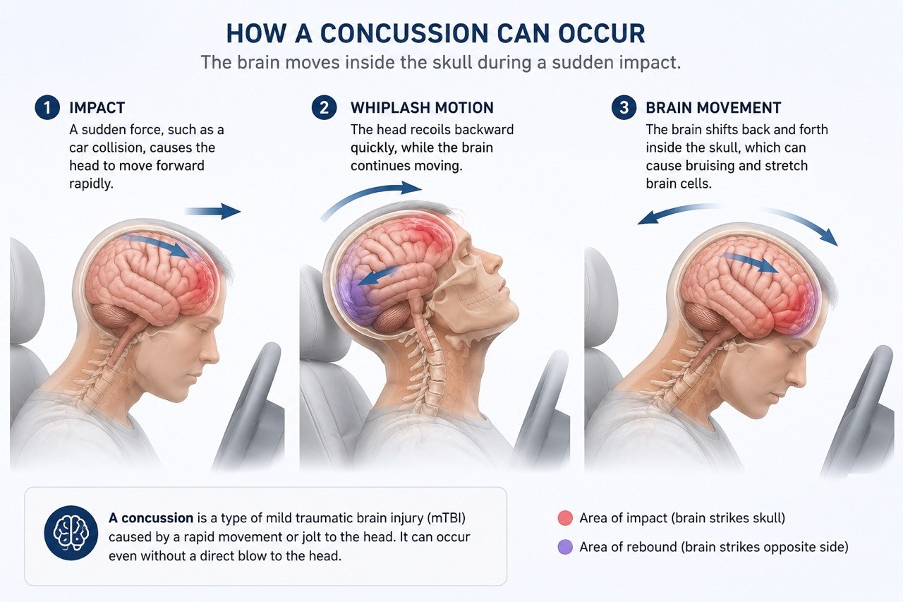
A concussion can occur even without a direct blow to the head when sudden acceleration and deceleration forces affect the brain. (AI-generated image)
The terms concussion and mild traumatic brain injury are often used together because a concussion is one of the most common forms of mTBI. For this reason, healthcare providers view concussion symptoms as part of the broader category of traumatic brain injury symptoms rather than as an isolated condition.
After a car accident, physicians evaluate not only how the injury occurred but also the symptoms a patient is experiencing to determine whether additional testing or treatment may be necessary.
Common Concussion Symptoms After a Car Accident
A concussion does not always look the way it is portrayed in movies. After a car accident, a person may remain conscious, carry on a conversation, and even feel relatively normal. Even so, a brain injury can cause a wide range of symptoms that affect physical well-being, concentration, memory, and everyday activities.
One of the most common concussion symptoms after a car accident is a headache. It may feel like pressure inside the head, a dull ache, or a throbbing sensation. If a headache after a car accident continues to worsen or occurs alongside other neurological symptoms, it should not be ignored.
Dizziness after a car accident is another common symptom. Some people experience mild unsteadiness, while others feel as though the room is moving or spinning. Balance problems may become noticeable while walking, climbing stairs, or making sudden movements.
Nausea and a general feeling of being unwell can also develop after a concussion. These symptoms are often attributed to stress following the accident, but they are also common signs of a mild traumatic brain injury. Repeated vomiting deserves particular attention, as it may indicate the need for prompt medical evaluation.
Some people experience changes in vision. Reading, working on a computer, or focusing on a single object for an extended period may become more difficult. Increased sensitivity to bright light is also common. Even normal lighting conditions may begin to cause discomfort or make other symptoms feel worse.
Not all concussion symptoms involve physical pain or discomfort. One of the most commonly reported complaints is brain fog after an accident. Many people describe it as feeling mentally slowed down or unable to think as clearly as usual. Concentrating, staying focused, and processing information may require more effort than before.
Memory problems are another common cognitive symptom. After a car accident, some people find it harder to remember new information, recall recent events, or switch between tasks. Although these changes may not be obvious to others, they can have a significant impact on work, school, and daily life.
Fatigue is also among the most common mild concussion symptoms. Even after resting, a person may feel unusually tired and have less energy than normal. When combined with other traumatic brain injury symptoms, persistent fatigue may indicate the effects of a concussion and should be monitored carefully.
| Symptom | What It May Feel Like |
|---|---|
| Headache | Pressure, dull pain, or throbbing in the head |
| Dizziness | Feeling unsteady, lightheaded, or off balance |
| Nausea | Stomach discomfort, nausea, or vomiting |
| Blurred Vision | Difficulty focusing or visual disturbances |
| Brain Fog | Feeling mentally slowed down or unfocused |
| Memory Problems | Forgetfulness or difficulty recalling information |
| Fatigue | Unusual tiredness and low energy levels |
| Sensitivity to Light and Noise | Discomfort around bright lights or loud sounds |
Delayed Concussion Symptoms: Why You May Feel Fine at First
After a car accident, some people feel completely normal and do not notice any immediate signs of injury. In part, this is due to the body’s stress response. The release of adrenaline helps a person react to the situation and can temporarily mask pain or other symptoms.
As the initial stress begins to fade, changes in how a person feels may become more noticeable. At first, this may involve a mild headache, unusual fatigue, or minor difficulty concentrating. Over time, delayed concussion symptoms may become more pronounced.
For this reason, healthcare providers recommend monitoring your condition not only on the day of the accident but also in the days that follow. If new symptoms develop or existing symptoms begin to worsen, it may be a sign that further medical evaluation is needed.
Concussion vs. Whiplash: What’s the Difference?
After a car accident, some people notice that recovery is not going as expected. Discomfort may linger, everyday tasks may feel more difficult, or there may be a general sense that something is not quite right. However, it is not easy to identify the cause of these changes.
In some cases, these symptoms may be related to a concussion. In others, they may be caused by whiplash. Although both injuries often result from the same collision, they affect different parts of the body.
Whiplash typically occurs when the head is suddenly forced forward and backward, affecting the muscles, ligaments, and [soft tissues] of the neck. A concussion, on the other hand, is a mild traumatic brain injury caused by acceleration and deceleration forces acting on the brain during a crash.
Some whiplash and concussion symptoms can overlap, making it difficult to determine the source of the problem without a medical evaluation. In general, cognitive symptoms such as memory issues, difficulty concentrating, and brain fog after an accident are more commonly associated with a concussion, while neck pain and stiffness are more often linked to whiplash.
In many cases, both injuries occur at the same time. For this reason, healthcare providers evaluate the overall pattern of symptoms and the circumstances of the accident rather than focusing on a single complaint.
The table below highlights some of the general differences between concussion and whiplash. However, symptoms can overlap, and both conditions may occur together after a car accident. Only a medical evaluation can determine the cause of your symptoms and help guide appropriate treatment.
| Symptom | Concusion | Whiplash |
|---|---|---|
| Headache | Common | Common |
| Dizziness | Common | Possible |
| Brain Fog | Common | Less Common |
| Memory Problems | Common | Uncommon |
| Sensitivity to Light/Noise | Common | Uncommon |
| Neck Pain | Possible | Common |
| Neck Stiffness | Uncommon | Common |
| Shoulder Pain | Less Common | Common |
| Difficulty Concentrating | Common | Possible |
| Balance Problems | Common | Possible |
Hidden Injuries After a Car Accident
After a car accident, most attention is focused on injuries that are immediately visible. If there are no serious cuts, broken bones, or severe pain, it is natural to assume that the incident is over and return to normal life as quickly as possible.
However, not all injuries are obvious right away. Some hidden injuries after a car accident may affect physical well-being, concentration, and daily activities even when a person initially feels relatively normal.
For this reason, even mild symptoms should not be dismissed. If symptoms persist, worsen, or begin to interfere with everyday life, it may be worth seeking medical evaluation. Some injuries become more noticeable over time and may require professional assessment despite the absence of visible signs of trauma.
When Should You See a Doctor After a Car Accident?
Not every symptom after a car accident indicates a serious injury. However, some signs should be evaluated by a medical professional, even if the crash itself seemed minor. It is important to pay attention not only to new symptoms but also to changes in symptoms that are already present.
A worsening headache after a car accident, repeated vomiting, memory loss, balance problems, confusion, or increasing difficulty performing routine tasks all warrant medical evaluation. Emergency care may be needed if there is loss of consciousness, rapid worsening of symptoms, numbness, or other significant neurological changes.
If you have concerns about how you feel after an accident, it is generally safer to seek medical evaluation rather than wait for symptoms to resolve on their own. Early assessment can help identify potential complications and determine whether your symptoms may be related to a concussion or another traumatic brain injury.
📞 Call (833) 863-6633 to Schedule an EvaluationHow Concussions and Traumatic Brain Injuries Are Diagnosed
Diagnosing a concussion involves more than a single test or scan. Physicians typically consider the details of the accident, the patient’s symptoms, and the results of a neurological evaluation. Together, this information helps determine whether a concussion or other traumatic brain injury may have affected brain function.
A neurological evaluation is often one of the first steps in the diagnostic process. During the examination, a healthcare provider may assess memory, attention, balance, coordination, speech, and other neurological functions. These findings help determine whether additional testing may be necessary.
A CT scan is commonly used when doctors need to rule out more serious injuries, such as bleeding in the brain or structural damage inside the skull. Although CT results are often normal in cases of concussion, the test can be an important part of the evaluation when concerning symptoms are present.
In some situations, an MRI may be recommended. MRI provides more detailed images of soft tissues and may be used when symptoms persist or when additional assessment is needed.
It is important to understand that diagnosis is not based on imaging alone. Normal CT or MRI results do not always mean that a concussion or mild traumatic brain injury is absent. Healthcare providers consider imaging findings alongside symptoms and clinical evaluation to gain a complete understanding of the patient’s condition.
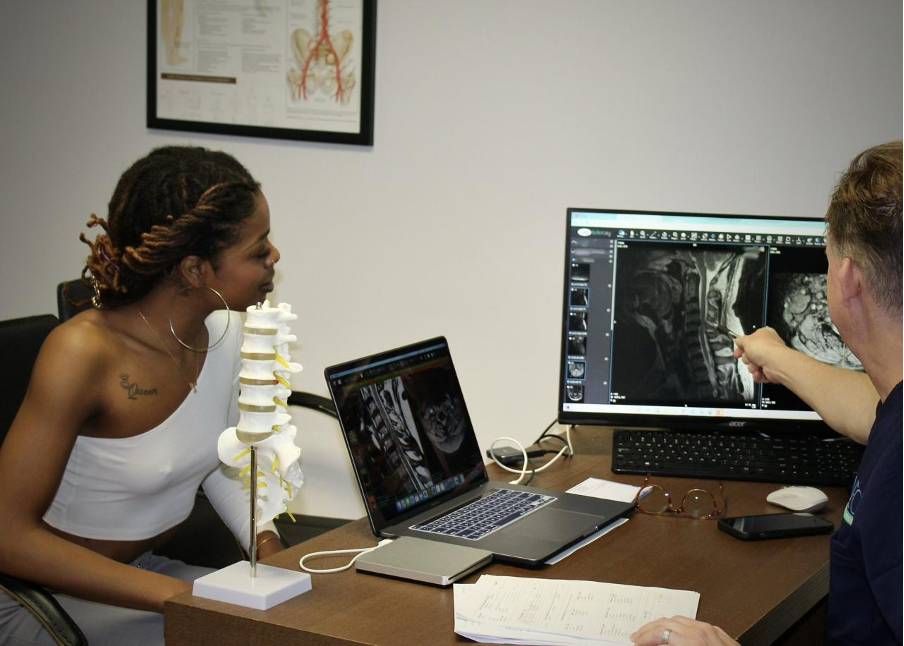
Diagnostic imaging and neurological evaluation may play an important role in identifying concussion and traumatic brain injury symptoms after a car accident. Photo: neosurgicalgroup
Patients who continue to experience symptoms after a car accident may benefit from a comprehensive traumatic brain injury evaluation. Additional information about traumatic brain injury symptoms, diagnosis, and treatment is available on the Traumatic Brain Injury page.
Recovery and Follow-Up Care After a Concussion
Recovery from a concussion does not look the same for everyone. Some people begin to feel better within a few days, while others need more time before returning to their normal routine.
A gradual improvement in symptoms such as headaches, dizziness, fatigue, and difficulty concentrating is often a sign that the brain is recovering. However, the process is not always linear. Some symptoms may temporarily return after a busy workday, a long drive, or a lack of rest.
Returning to work, school, driving, and physical activity should also be a gradual process. If routine activities begin to worsen symptoms, additional recovery time may be needed.
In some cases, the effects of a head injury after a car accident last longer than expected. Ongoing headaches, neck pain, muscle tension, fatigue, and other symptoms may continue to affect daily life weeks after the crash.
If symptoms persist longer than expected, consulting a specialist may help determine the next steps in recovery. Patients who continue to experience pain or other accident-related symptoms may also benefit from learning more about available Pain Management options.
Concerned About Symptoms After a Car Accident?
It is not always easy to determine whether changes in how you feel are related to a car accident. In some cases, additional evaluation may be needed to identify the cause of ongoing symptoms and determine whether further testing is appropriate.
The specialists at Neo Surgical Group treat patients who have suffered injuries in motor vehicle accidents, including concussions and other traumatic brain injuries. With multiple locations throughout Florida, the practice provides evaluation and treatment for individuals experiencing symptoms after a crash.
Same-day appointments may be available. If you continue to experience symptoms after an accident or have concerns about a possible brain injury, a consultation with a specialist can help determine the most appropriate next steps.
📞 Call (833) 863-6633 to Schedule an EvaluationFAQ
In most cases, sleeping after a concussion is not prohibited. However, if you develop concerning symptoms such as a worsening headache, repeated vomiting, severe confusion, or loss of consciousness after a car accident, you should seek medical attention promptly.
Yes. Some people notice that their symptoms become more noticeable after working on a computer, engaging in physical activity, getting too little sleep, or concentrating for extended periods. This does not necessarily mean the injury is getting worse, but it should be monitored.
Yes. A concussion can occur even after a relatively minor collision. A severe impact or significant vehicle damage is not always required for a brain injury to occur.
Recovery varies from person to person. Some individuals begin to feel better within days or weeks, while others may require a longer recovery period before symptoms fully improve.
If a concussion causes dizziness, difficulty concentrating, vision problems, or slowed reaction time, driving may not be safe. It is best to discuss returning to driving with a healthcare provider.
Ignoring concussion symptoms may allow headaches, memory problems, concentration difficulties, and other symptoms to persist longer than necessary. Without a proper evaluation, it can also be more difficult to rule out more serious injuries.
Yes. Concussion symptoms in children and teenagers may differ from those seen in adults. A child may become more irritable, tire more easily, struggle with schoolwork, or complain of headaches.
Yes. The same crash can cause both a whiplash injury and a concussion. This is one reason healthcare providers evaluate the overall pattern of symptoms rather than focusing on a single complaint.
No. A headache after a car accident can have several causes, including muscle tension, stress, or neck injuries. However, if it occurs alongside other symptoms, a medical evaluation may be appropriate.
Yes. CT scans are often normal in cases of concussion. For this reason, physicians consider imaging results together with symptoms, neurological findings, and the details of the injury when making a diagnosis.
Bibliography
- https://www.cdc.gov/traumatic-brain-injury/signs-symptoms/index.html
- https://www.cdc.gov/heads-up/about/index.html
- https://pmc.ncbi.nlm.nih.gov/articles/PMC1924661/
- https://www.archives-pmr.org/article/S0003-9993%2813%2901068-X/fulltext
- https://pmc.ncbi.nlm.nih.gov/articles/PMC4977400/
- https://www.diva-portal.org/smash/get/diva2%3A567969/FULLTEXT01.pdf
- https://concussionsontario.org/sites/default/files/2023-03/First_Edition.pdf
- https://qbi.uq.edu.au/brain/concussion/delayed-concussion-symptoms
- https://sportsmedicine.mayoclinic.org/condition/concussion/
- https://www.ninds.nih.gov/health-information/disorders/traumatic-brain-injury-tbi