
Back Pain After a Car Accident: Causes, Delayed Symptoms, Treatment and Recovery

Back pain may not appear immediately after a car accident. Even seemingly minor collisions can cause injuries that require medical evaluation.
(AI-generated image)
Back pain is one of the most common complaints after a car accident. It may begin immediately after the collision or develop hours or even days later. While many people assume it is only muscle soreness, back pain can also result from injuries affecting the muscles, ligaments, spinal discs, or nerves.
When back pain develops after a car accident, many people search Google for terms like "back pain after car accident" to understand whether their symptoms are normal or may indicate a more serious injury. However, the answer is not always straightforward. Back pain may result from muscle strain, ligament sprains, herniated or bulging discs, irritated nerves, or other spinal injuries that cannot be diagnosed based on symptoms alone.
In this article, we'll explain why back pain can occur after a car accident, why symptoms are sometimes delayed, which warning signs should never be ignored, when an MRI after a car accident may be recommended, and when it's time to seek medical care.
Why Does Your Back Hurt After a Car Accident?
During a car accident, your spine is exposed to forces it is not designed to handle during everyday activities. Even a low-speed collision can suddenly bend, twist, compress, or overstretch the spine. That's why back pain after auto accident can develop even after a crash that initially seems minor.
The impact happens so quickly that your muscles do not have enough time to protect the spine. While the seat belt restrains your body, the structures inside your spine continue moving due to inertia, placing stress on the muscles, ligaments, intervertebral discs, joints, and nerves.
The symptoms you experience depend on which structures have been injured.
Muscles
Overstretched or torn back muscles typically cause dull, aching pain, muscle spasms, and discomfort that worsens with movement.
Ligaments
Overstretched ligaments can lead to stiffness, pain with bending or twisting, and a reduced range of motion.
Intervertebral Discs
A strong impact can cause a disc to bulge, tear, or herniate, sometimes resulting in a bulging disc after car accident or a herniated disc, particularly if degenerative changes were already present before the crash.
Nerves
When a damaged disc or inflamed tissue compresses a spinal nerve, symptoms may include numbness, tingling, burning pain, or pain that radiates into an arm or leg.
Whiplash can also contribute to back pain. Although it primarily affects the neck, the sudden forward-and-backward motion places stress on the entire spine, allowing pain to develop in both the upper and lower back.
Because different spinal injuries can produce similar symptoms, it is often impossible to identify the exact cause of pain based on symptoms alone. Persistent or worsening back pain after a car accident should be evaluated by a medical professional rather than dismissed as a routine injury.
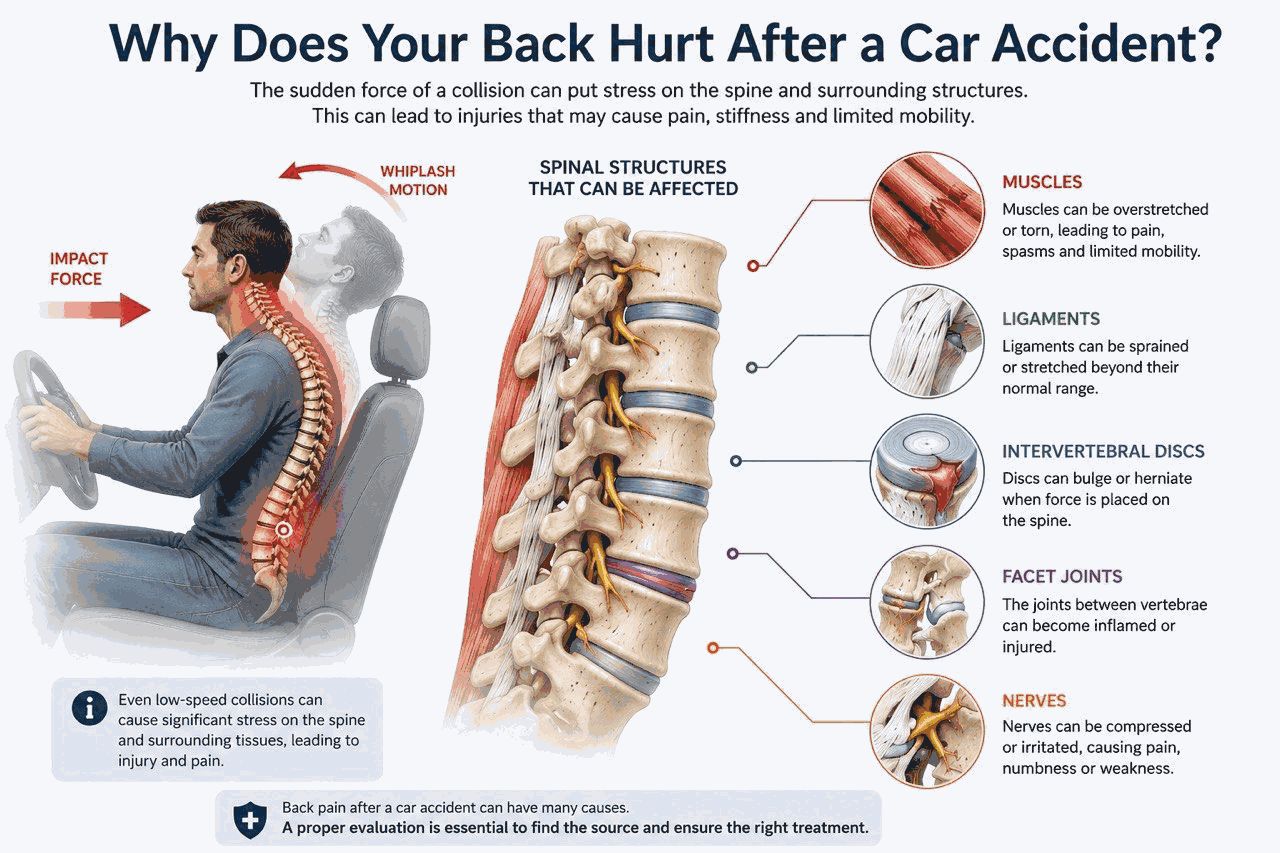
A car accident can injure multiple structures of the spine, including muscles, ligaments, intervertebral discs, facet joints and spinal nerves.
(AI-generated image)
Concerned About Back Pain After a Car Accident? Call Neo Surgical Group:
📞 (833) 863-6633Lower Back Pain After a Car Accident
The lower back is one of the most vulnerable parts of the spine during a car accident. As a result, lower back pain after car accident is one of the most common complaints following a collision. The lumbar spine supports much of the body's weight and is involved in nearly every movement. During a collision, it can be compressed, twisted, or forced beyond its normal range of motion, increasing the risk of injury.
One of the most common causes of pain is a lumbar strain, an injury to the lower back muscles that typically causes aching pain, tightness, muscle spasms, and discomfort that worsens with movement.
A lumbar sprain affects the ligaments that help stabilize the spine. It often causes stiffness, reduced mobility, and discomfort, especially after resting or remaining in the same position for a long time.
Not all lower back pain is caused by soft tissue injuries. A collision can also result in a herniated disc after car accident or a bulging disc, which may irritate or compress nearby nerve roots.
Another possible cause is nerve compression. In addition to pain, it may cause numbness, reduced sensation, weakness in one leg, or difficulty controlling normal leg movements. These symptoms are more likely to suggest nerve involvement than a simple muscle strain.
Pain intensity does not always reflect the severity of an injury. A minor muscle strain may be very painful, while a damaged disc can cause only mild symptoms at first. Persistent or worsening pain should never be ignored.
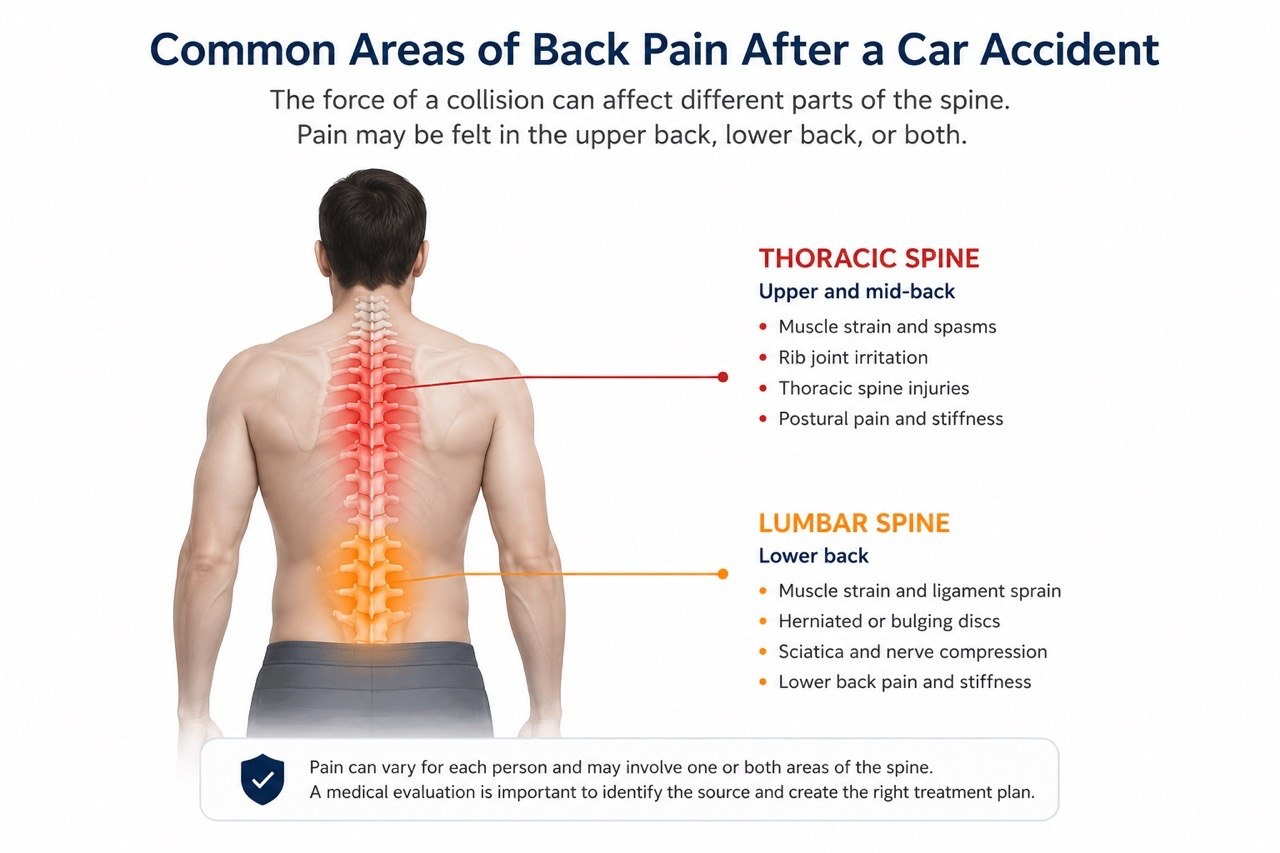
Comparison of the thoracic and lumbar regions of the spine, highlighting the most common areas of back pain after a car accident.
(AI-generated image)
Upper Back Pain After a Car Accident
Although lower back injuries are more common after a collision, upper back pain after car accident is also a frequent complaint. The causes differ because the thoracic spine has a different structure and function than the lower back.
Unlike the lumbar spine, the thoracic spine is less flexible and is connected to the ribs, which help stabilize the spine and protect the internal organs. During a collision, this region can still be exposed to significant force, especially if the body is suddenly thrown forward, backward, or sideways.
One of the most common causes of upper back pain is muscle injury. Overstretched or strained muscles may cause pain between the shoulder blades, muscle tightness, and stiffness that often becomes worse after sitting for long periods, twisting the torso, or taking a deep breath.
Another possible source of pain is injury to the costovertebral joints, which connect the ribs to the spine. When these joints become inflamed or irritated, they may cause localized pain that worsens with deep breathing, coughing, or changes in body position.
The ribs themselves may also be injured during a more severe impact. Rib fractures are more common in high-impact collisions and typically cause sharp pain that worsens with deep breathing, coughing, laughing, or upper body movement. Because rib fractures and thoracic spine injuries can cause similar symptoms, it is often difficult to determine the source of pain without an examination.
Although less common, the impact can also injure the intervertebral discs in the thoracic spine. These injuries may cause pain between the shoulder blades, a feeling of pressure or tightness in the upper back, or pain that radiates around the chest.
Upper back pain may also occur alongside whiplash and back pain, as the sudden forward-and-back motion places stress on the muscles, ligaments, and joints throughout the upper spine.
Unlike lower back pain, which often radiates into the buttock or leg, upper back injuries are more likely to cause localized pain between the shoulder blades, stiffness, and discomfort during shoulder movement or deep breathing. If pain is accompanied by numbness, arm weakness, or other neurological symptoms, it may indicate a more serious injury and should be evaluated promptly.
Why Can Back Pain Be Delayed After a Car Accident?
Many people assume that if they feel fine immediately after a collision, they have avoided a serious injury. In reality, delayed lower back pain after car accident is one of the most common reasons people seek medical care in the days following a crash.
During a collision, the body releases adrenaline and other stress hormones that can temporarily reduce the sensation of pain. As these hormones wear off, symptoms often become more noticeable. The same delayed response can occur after a head injury. If you develop headaches, dizziness, nausea, or difficulty concentrating after the accident, read more about concussion symptoms after a car accident.
Inflammation is another common cause of delayed pain. When muscles, ligaments, or other soft tissues are injured, swelling gradually increases over the first 24 to 72 hours, making the affected tissues more sensitive and causing pain to become more noticeable.
Delayed pain is not always related to soft tissue injuries. Symptoms caused by a herniated disc after car accident, irritated nerves, or other hidden spinal injuries may also appear gradually. If your symptoms do not improve, become more severe, or are accompanied by numbness, weakness, or pain that radiates into an arm or leg, it is important not to delay a medical evaluation.
📞 Get Evaluated for Delayed SymptomsHidden Back Injuries After a Car Accident
Some spinal injuries can be difficult to identify without a proper medical evaluation because their symptoms often resemble a simple muscle strain. For this reason, doctors look beyond the location and intensity of pain after a collision and also consider the possibility of hidden injuries after car accident — conditions that cannot be confirmed or ruled out based on symptoms alone.
These injuries may include a herniated disc after car accident, a bulging disc, soft tissue injuries, damage to the spinal nerves, and spinal instability. Although these conditions affect different structures of the spine, they can initially present with similar symptoms, such as mild pain, stiffness, or reduced mobility.
For example, a herniated disc or bulging disc may irritate nearby nerve roots, causing pain, numbness, or tingling, while spinal instability can develop when damaged ligaments no longer provide adequate support for the spine.
Because different spinal injuries can produce similar symptoms, it is often impossible to identify the exact cause of pain without further testing. If your discomfort persists, becomes worse, or is accompanied by numbness, weakness, or limited mobility, it is important to undergo a medical evaluation to rule out a more serious spinal injury.
Common Symptoms of a Serious Back Injury
Back pain can feel very different from one person to another after a car accident. For some, it remains localized and gradually improves. For others, it spreads to other parts of the body, is accompanied by numbness, or begins to limit everyday movement.
While symptoms alone cannot determine the exact diagnosis, certain patterns are more commonly associated with specific types of spinal injuries.
Sharp pain is often linked to muscle strains, ligament injuries, or damage to an intervertebral disc. If the pain becomes severe or makes it difficult to move, it should not be ignored.
Muscle spasms are the body's natural protective response to injury and commonly occur with soft tissue damage.
Stiffness is commonly associated with inflammation affecting the muscles, ligaments, or spinal joints. It is often most noticeable in the morning or after sitting or standing in the same position for a long time.
Numbness and tingling are more common when the injury involves the spinal nerves. If these symptoms spread into an arm or leg or continue to worsen, medical attention is recommended.
Weakness may indicate nerve compression or another type of neurological injury and should be evaluated promptly.
Burning pain and radiating pain often occur when a nerve is irritated or compressed. Unlike muscle pain, these sensations may extend well beyond the original site of the injury.
Pain that travels from the lower back through the buttock and down the leg may be a sign of sciatica symptoms, which are commonly caused by irritation or compression of the sciatic nerve.
| Symptom | Possible Cause |
|---|---|
| Localized lower back pain | Muscle strain or ligament sprain |
| Pain shooting down the leg | Herniated disc or sciatica |
| Numbness | Nerve compression |
| Tingling | Nerve irritation |
| Muscle weakness | Nerve injury |
| Burning pain | Nerve involvement |
| Upper back pain | Thoracic spine injury or muscle strain |
| Severe back pain with limited mobility | Disc injury, fracture, or serious soft tissue damage |
These symptoms do not always indicate a serious spinal injury. However, if they occur together, become more severe over time, or new symptoms develop after a car accident, it is important not to delay a medical evaluation.
Signs of a Herniated Disc or Nerve Damage After a Car Accident
After a car accident, it is not always easy to tell the difference between a simple muscle strain and a more serious injury involving an intervertebral disc or spinal nerve. However, certain symptoms are more likely to indicate a significant injury and should not be ignored.
One of the most important warning signs is pain that extends beyond the back. If the pain radiates into the buttock, leg, or arm and is accompanied by numbness or tingling, it may be a sign of a herniated disc after car accident, a pinched nerve after car accident, or another type of nerve injury.
Muscle weakness should also be taken seriously. If everyday movements become more difficult or an arm or leg feels less strong or responsive than usual, you should not delay an evaluation.
With sciatica after car accident, pain typically begins in the lower back, travels through the buttock, and continues down the leg, often accompanied by a burning sensation, numbness, or reduced sensation.
The sooner the underlying cause of these symptoms is identified, the sooner appropriate treatment can begin, helping reduce the risk of long-term complications.
📞 Get a Spine EvaluationWhen You Need an MRI After a Car Accident
After a car accident, many people wonder whether they need an MRI right away. The answer depends on your symptoms, physical examination, and the type of injury your doctor suspects. The most appropriate imaging test is selected based on which structures of the spine need to be evaluated.
If a fracture is suspected, an X-ray is usually the first imaging test performed. It provides a clear view of the bones and can quickly identify most fractures.
If a more detailed assessment of the bones is needed, a CT scan may be recommended. CT provides detailed images of the spine and is often used to rule out fractures or other significant bone injuries.
An MRI after car accident is typically recommended when symptoms suggest injury to the intervertebral discs, spinal nerves, ligaments, or other soft tissues. Unlike X-rays or CT scans, MRI can visualize structures that are not visible on standard imaging, making it one of the most valuable tools for diagnosing a herniated disc, nerve compression, or other hidden spinal injuries.
If symptoms suggest ongoing nerve damage, or if your doctor needs to assess how well the nerves are communicating with the muscles, Electromyography (EMG) may also be recommended.
| Test | What It Shows |
|---|---|
| X-Ray | Fractures |
| CT Scan | Bone injuries |
| MRI | Discs, nerves, soft tissues |
| EMG | Nerve damage |
In many cases, a single imaging test is not enough to fully evaluate a spinal injury. Combining different diagnostic tools allows your doctor to better understand the extent of the damage and develop the most appropriate treatment plan. If the evaluation reveals an injury to the spine, an intervertebral disc, or the spinal nerves, the next step may be a consultation with a specialist in Neurosurgery / Orthopedics.
Not Sure Which Imaging Test You Need? Call Neo Surgical Group:
📞 (833) 863-6633How Long Does Back Pain Last After a Car Accident?
The duration of back pain after a car accident depends on several factors, including the severity of the injury, the type of tissues involved, your age, overall health, and how soon treatment begins. For some people, symptoms improve within a few weeks, while others may require several months to recover.
In many cases, muscle and ligament injuries begin to heal during the first few weeks after the accident. However, if the pain persists, becomes more severe, or new symptoms develop, it may be a sign of a more significant injury that requires further evaluation.
| Recovery Phase | What to Expect |
|---|---|
| Acute Phase (0–4 Weeks) | Pain, stiffness and muscle spasms are usually most noticeable during the first days after the accident. Many soft tissue injuries begin to improve with appropriate treatment during this period. |
| Subacute Phase (4–12 Weeks) | Pain often becomes less intense, mobility gradually improves and most patients continue returning to their normal daily activities. |
| Chronic Phase (12+ Weeks) | Persistent pain beyond three months may indicate chronic inflammation, nerve involvement or another condition that requires further evaluation. |
Although these recovery timelines are common, they are not the same for everyone. For example, a mild muscle strain may heal much sooner, while an injury involving an intervertebral disc or the spinal nerves often requires a longer recovery period and ongoing care.
Recovery often begins with conservative treatment, which may include physical therapy, a gradual return to physical activity, medications, and other non-surgical approaches. These treatments help reduce pain, restore mobility, and support recovery without surgery.
If your pain has not improved after several weeks or begins to interfere more with your daily activities, do not assume it will resolve on its own. In this situation, it is important to follow up with your healthcare provider so your condition can be reassessed and your treatment plan adjusted if necessary.
Can Back Pain Become Chronic?
For most people, back pain gradually improves as injured tissues heal. However, chronic back pain after accident can develop, particularly if the original injury is not diagnosed or treatment is delayed.
Back pain is generally considered chronic when it lasts longer than 12 weeks. While it may result from muscle or ligament injuries, it can also be caused by damage to the intervertebral discs, irritation of the spinal nerves, or problems affecting the spinal joints.
A car accident can also aggravate pre-existing degenerative changes in the spine. Although these age-related changes may have caused little or no discomfort before the collision, the trauma can trigger ongoing pain and reduced mobility.
Delayed or inadequate treatment may further increase the risk of chronic pain. Identifying the underlying cause early and beginning appropriate treatment improves the chances of recovery and reduces the risk of long-term complications.
If pain continues despite treatment or begins to interfere with your daily activities, your doctor may recommend a Pain Management program to help relieve pain, improve mobility, and enhance your quality of life.
When Should You See a Doctor?
Mild muscle soreness is common for a few days after a car accident and often improves on its own. However, some symptoms should never be ignored. You should see a doctor if you:
- have pain that continues to get worse instead of improving;
- develop numbness or tingling;
- notice weakness in an arm or leg;
- have pain that radiates into your arms or legs;
- experience difficulty maintaining your balance;
- have problems controlling your bladder or bowels;
- continue to have pain for several weeks or find that it interferes with your normal daily activities.
These symptoms do not always mean you have a serious spinal injury, but they may indicate damage to an intervertebral disc, the spinal nerves, or another complication related to the accident. If your evaluation confirms a spinal injury or persistent neurological symptoms, your treatment plan may include a consultation with a spine specialist in Neurosurgery / Orthopedics.
📞 Get Evaluated for Delayed SymptomsFAQ
Yes. A sudden impact can contribute to a herniated disc after car accident, especially if the disc was already weakened. Symptoms may include back pain, numbness, tingling, or pain that radiates into an arm or leg.
Not always. An MRI is usually recommended when symptoms suggest injury to the discs, nerves, or other soft tissues, or when pain does not improve with initial treatment.
A normal X-ray does not rule out injuries to the muscles, ligaments, intervertebral discs, or spinal nerves. If pain persists, your doctor may recommend additional imaging, such as an MRI.
Yes. Pain intensity does not always reflect the severity of an injury. Some disc or nerve injuries may cause only mild symptoms at first but become more noticeable over time.
Most people recover with appropriate treatment. However, untreated injuries, nerve damage, or pre-existing degenerative changes can increase the risk of chronic back pain after accident.
Yes. Adrenaline released during the accident can temporarily mask pain, while inflammation develops gradually over the following 24 to 72 hours.
It depends on the cause of the pain. Light activity may be appropriate in some cases, but strenuous exercise should be avoided until a healthcare provider has evaluated your injury.
Seek emergency care if you have severe weakness, loss of bladder or bowel control, difficulty walking, or other sudden neurological symptoms after a car accident.
Yes. Whiplash can strain muscles and ligaments throughout the spine, contributing to pain in both the upper and lower back.
Mild muscle strains often improve with conservative treatment. However, persistent or worsening pain should be evaluated to rule out a more serious spinal injury.
Bibliography
- https://orthoinfo.aaos.org/en/diseases--conditions/low-back-pain/
- https://www.aans.org/patients/conditions-treatments/herniated-disc/
- https://www.aans.org/patients/conditions-treatments/low-back-pain/
- https://www.aans.org/patients/conditions-treatments/low-back-strain-and-sprain/
- https://acsearch.acr.org/docs/69483/narrative/
- https://pmc.ncbi.nlm.nih.gov/articles/PMC2684148/
- https://pubmed.ncbi.nlm.nih.gov/24718062/
- https://www.mayoclinic.org/diseases-conditions/herniated-disk/diagnosis-treatment/drc-20354101
- https://my.clevelandclinic.org/health/diseases/22564-radiculopathy
- https://www.spine.org/portals/0/assets/downloads/researchclinicalcare/guidelines/lowbackpain.pdf
- https://pmc.ncbi.nlm.nih.gov/articles/PMC1495170/