
Nerve Damage After a Car Accident: Symptoms, Causes & Treatment

After a car accident, muscle pain, stiffness, and bruising may seem like expected consequences of the impact. But when these symptoms are accompanied by numbness, tingling, burning sensations, or weakness in an arm, leg, or another part of the body, they may be signs of nerve damage after a car accident.
Nerve damage does not always cause symptoms right away. Some people notice the first signs within a few hours, while others may not experience them until several days later. That's why it's important not to ignore signs of nerve damage after a car accident, even if you felt relatively well immediately after the crash.
If you're experiencing numbness or tingling after a car accident, seek a medical evaluation as soon as possible.
What Is Nerve Damage After a Car Accident?
Nerves act like communication lines between the brain and spinal cord and the rest of the body. They carry signals that allow you to feel touch, pain, and temperature and control muscle movement. If a nerve is stretched, compressed, or otherwise damaged during a car accident, these signals can be disrupted.
That is why a nerve injury after a car accident may feel different from a typical muscle injury. A muscle strain usually causes localized pain and stiffness that gradually improve as the tissues heal. Nerve damage, on the other hand, may cause numbness, tingling, burning or shooting pain, reduced sensation, or muscle weakness.
How Can a Car Accident Cause Nerve Damage?
During a car accident, nerves can be damaged by more than just a direct impact. Nerve injuries may result from excessive stretching, compression, inflammation, or injuries to the spine and surrounding tissues.
Below are some of the most common causes of nerve damage after a car accident:
Whiplash. The sudden back-and-forth movement of the head can stretch the muscles, ligaments, and other soft tissues in the neck. This may irritate or compress nearby nerves, causing pain, numbness, or tingling that can radiate into the shoulder or arm.
Herniated Disc. A car accident can cause an intervertebral disc to shift or rupture. If the damaged disc compresses or irritates a nerve root, it may cause radiating pain, numbness, tingling, or muscle weakness. When a nerve root in the cervical spine is affected, symptoms may be associated with cervical radiculopathy.
Direct Trauma and Peripheral Nerve Injury. A forceful impact to the arm, leg, shoulder, or another part of the body can directly damage a peripheral nerve. Depending on the affected nerve, symptoms may include localized numbness, tingling, weakness, or pain.
Seatbelt and Airbag Injuries. Seatbelts and airbags significantly reduce the risk of serious injury, but the forces involved in a severe collision can put pressure on soft tissues. In some cases, this may compress or irritate nearby nerves.
Swelling. Inflammation and swelling can develop after an injury. As the surrounding tissues swell, they may begin to put pressure on a nearby nerve, which is one reason some symptoms do not appear immediately.
Scar Tissue. As injured tissues heal, scar tissue may sometimes form around or near a nerve, potentially restricting its normal movement or placing additional pressure on it.
Fractures and Spinal Cord Compression. Broken bones and more serious spinal injuries can compress nerve structures or the spinal cord. These injuries require immediate medical attention.
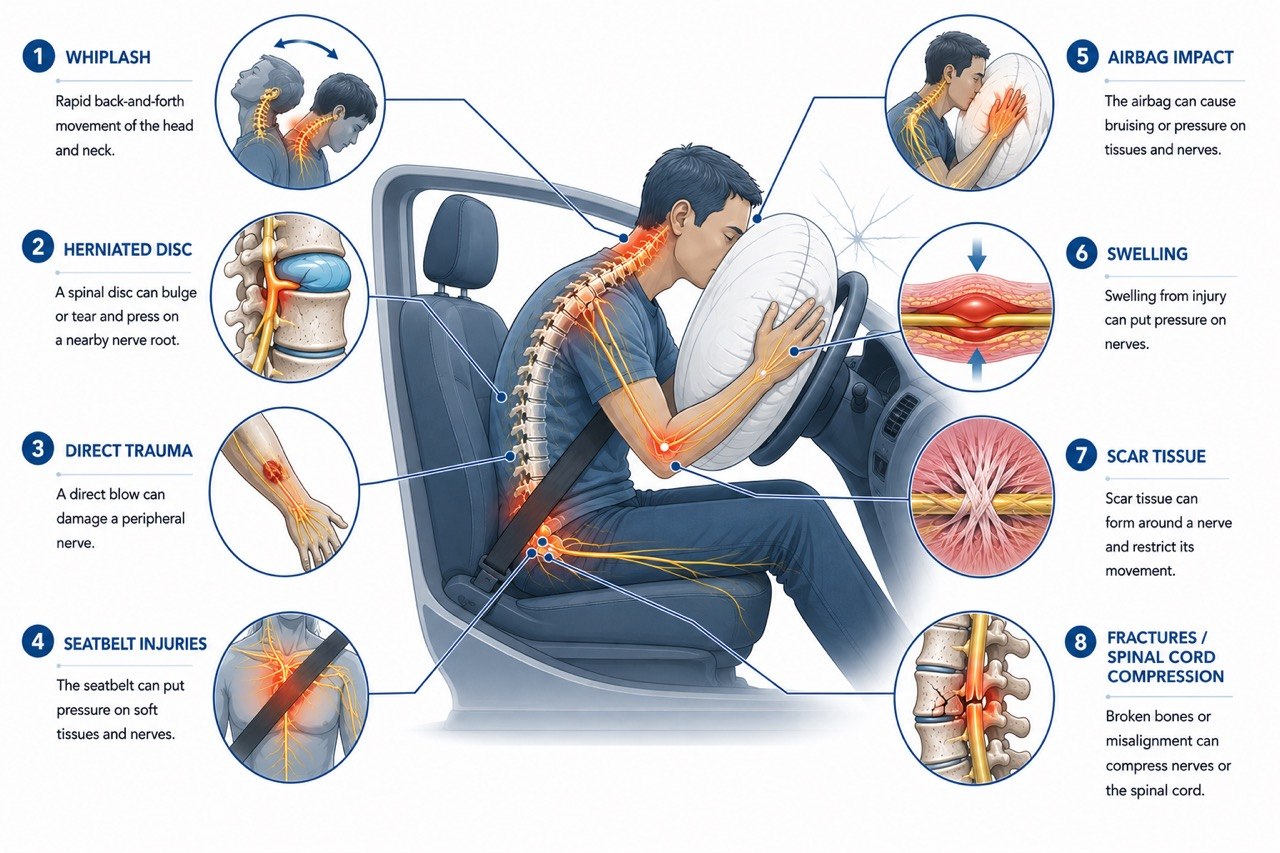
Common mechanisms of nerve damage after a car accident.
(AI generated)
Can Nerve Damage Symptoms Be Delayed?
In some cases, symptoms of nerve damage may not become noticeable immediately after a car accident. Instead, they can develop several hours or even days later. This does not mean the injury occurred later – the nerve may have already been affected, while the symptoms develop gradually.
Immediately after a collision, the body releases adrenaline and other stress hormones. These can temporarily reduce the perception of pain and make less noticeable symptoms easier to overlook. As their effects wear off, you may begin to notice discomfort that was not apparent right after the accident.
Inflammation and swelling are another common reason for delayed symptoms. After an injury, surrounding tissues may gradually swell and begin to put pressure on a nearby nerve. This is why numbness, tingling, burning sensations, or weakness may not appear until several hours later or even the following day.
If a herniated disc is causing the nerve injury, symptoms may also worsen gradually. As inflammation increases, pressure on the nerve root can become more pronounced, causing pain to radiate into an arm or leg, along with numbness or muscle weakness.
Don't ignore numbness, tingling, or weakness after a car accident.
📞 Schedule an EvaluationCommon Signs and Symptoms of Nerve Damage
Nerve damage after a car accident can cause different symptoms depending on which nerve is affected and how severe the injury is. Below are the most common symptoms of nerve damage after a car accident and their possible causes.
| Symptom | What It May Feel Like | Possible Cause |
|---|---|---|
| Numbness | A "dead" feeling or reduced sensation in the affected area | Nerve compression or injury |
| Tingling (Pins and Needles) | Prickling, buzzing, or "pins and needles" sensation | Irritated or compressed nerve |
| Burning Pain | Persistent burning or stinging pain | Damage to sensory nerves |
| Shooting or Radiating Pain | Sharp pain traveling into the arm, leg, hand, or foot | Pinched nerve or herniated disc |
| Muscle Weakness | Difficulty gripping, lifting, walking, or climbing stairs | Damage to motor nerves |
| Loss of Sensation | Reduced ability to feel touch, temperature, or pain | More significant nerve dysfunction |
| Hypersensitivity | Even light touch causes discomfort or pain | Increased nerve sensitivity after injury |
| Loss of Coordination or Balance | Clumsiness, poor balance, or difficulty controlling movements | Nerve injury affecting muscle control or sensation |
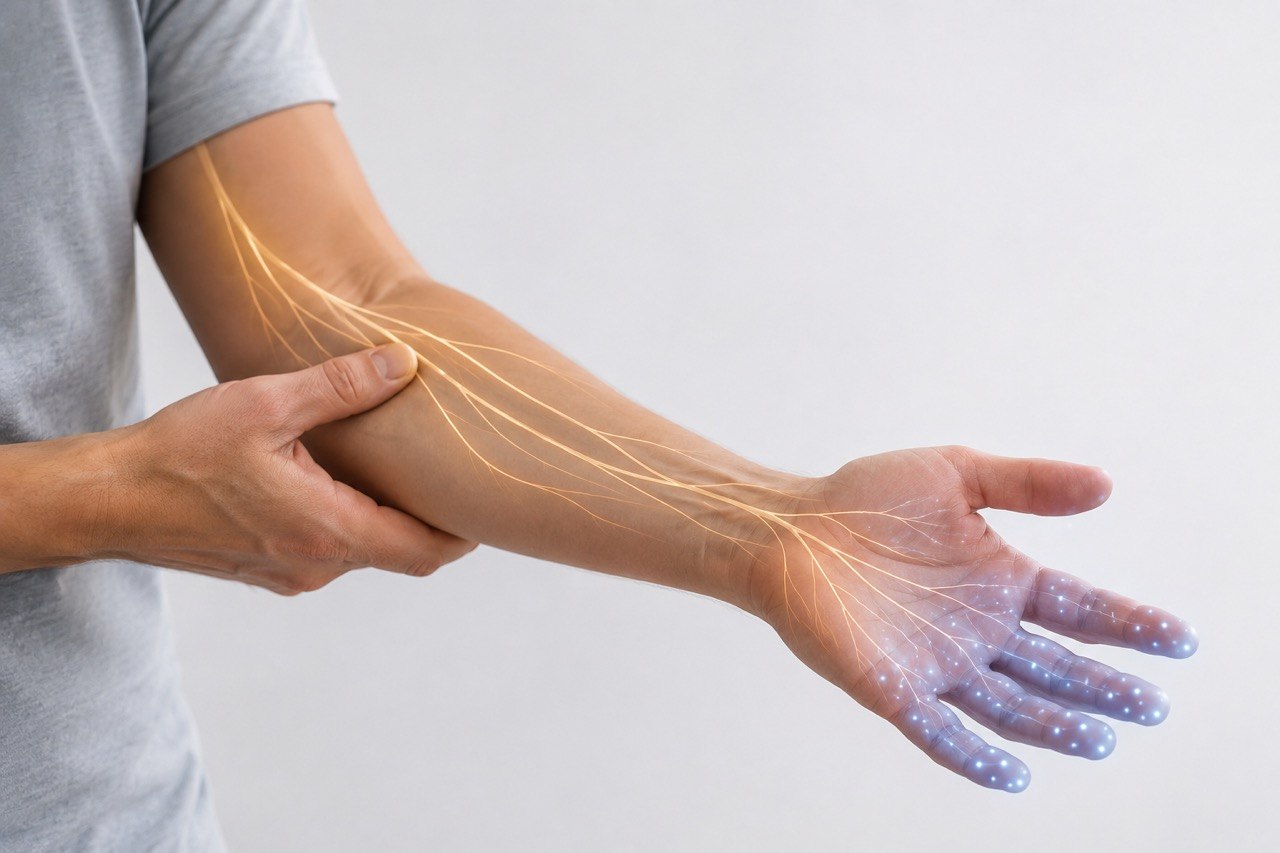
Common sensations associated with nerve damage.
(AI generated)
When Are Nerve Damage Symptoms a Medical Emergency?
Most symptoms of nerve damage require a medical evaluation, but some may indicate a more serious injury to the nervous system or spine and require immediate medical attention.
| Symptom | Why It's Dangerous | What to Do |
|---|---|---|
| Rapidly worsening muscle weakness | May indicate progressive nerve damage or spinal cord compression | Seek emergency medical care immediately |
| Complete loss of sensation | May suggest severe nerve injury or significant nerve compression | Go to the nearest emergency department |
| Loss of bladder or bowel control | Can be a sign of serious spinal cord or cauda equina injury | Call emergency services immediately |
| Severe pain that continues to worsen | May indicate increasing pressure on a nerve or another serious injury | Seek urgent medical evaluation |
| Signs of spinal cord injury (difficulty walking, loss of coordination, paralysis, or numbness affecting both arms or both legs) | May indicate a potentially life-threatening spinal injury | Call emergency services immediately |
Nerve Damage vs. Muscle Injury: What's the Difference?
After a car accident, it can be difficult to distinguish nerve damage from a muscle injury because both can cause pain. However, the symptoms, sensations, and methods used to diagnose these conditions can be quite different.
| Feature | Nerve Damage | Muscle Injury |
|---|---|---|
| Pain | Burning, shooting, radiating, or electric-like pain | Aching, soreness, or tenderness |
| Sensation | Numbness, tingling, loss of sensation, or hypersensitivity | Usually normal sensation |
| Muscle Strength | May cause weakness or difficulty moving the affected limb | Strength is usually preserved, although movement may be painful |
| Location of Symptoms | Can spread along the path of a nerve into the arm or leg | Usually stays near the injured muscle |
| Diagnosis | Neurological examination, MRI, EMG, and Nerve Conduction Study | Physical examination and, when needed, imaging to evaluate soft tissue injuries |
How Is Nerve Damage Diagnosed?
Diagnosing nerve damage does not begin with an MRI or other diagnostic tests. It starts with a detailed discussion with your doctor and a physical examination. Your doctor will ask how the accident happened, when your symptoms first appeared, and how they have changed over time.
A neurological examination is then performed. Your doctor will assess muscle strength, sensation, reflexes, and coordination to determine which nerves may be affected. If a more serious injury is suspected, additional diagnostic tests may be needed.
| Diagnostic Test | What It Shows | When It's Used |
|---|---|---|
| Physical & Neurological Examination | Assesses muscle strength, reflexes, sensation, and coordination | Performed during the initial evaluation |
| X-ray | Detects fractures or spinal alignment problems | Used when a bone injury is suspected |
| MRI | Shows nerves, spinal discs, ligaments, and other soft tissues | Recommended if nerve compression, a herniated disc, or spinal injury is suspected |
| CT Scan | Provides detailed images of bones and certain traumatic injuries | Used when fractures or complex trauma need further evaluation |
| Electromyography (EMG) | Evaluates how well muscles respond to nerve signals | Used when nerve injury is suspected or symptoms persist |
| Nerve Conduction Study (NCS) | Measures how quickly electrical signals travel through nerves | Helps identify the location and severity of nerve damage |
In some cases, EMG and nerve conduction studies are performed together because the tests complement each other and can help determine the severity and location of nerve damage.
Persistent numbness or weakness should always be evaluated by a specialist.
Treatment for Nerve Damage After a Car Accident
Treatment for nerve damage after a car accident is tailored to each patient. The appropriate approach depends on the cause of the injury, the severity of the symptoms, and the results of the medical evaluation. In most cases, treatment begins with conservative methods, while more invasive procedures are considered only when necessary.
Conservative Treatment
For mild to moderate nerve injuries, treatment usually begins with rest, activity modification, medication, and monitoring of symptoms. In many cases, these measures can help reduce inflammation and create favorable conditions for the nerve to recover.
Physical Therapy
Once acute pain begins to improve, your doctor may recommend physical therapy. Specific exercises can help restore mobility, strengthen the surrounding muscles, and reduce stress on the affected nerve.
Pain Management
If pain persists or begins to interfere with daily activities, additional pain management options may be considered. The goal is to reduce symptoms, improve quality of life, and help you return to your usual activities.
Diagnostic & Therapeutic Injections
In some cases, your doctor may recommend diagnostic or therapeutic injections. These injections can help reduce inflammation around the nerve, relieve pain, and help identify the source of the symptoms.
Surgery
Surgery is not necessary for most patients with nerve damage. Surgical treatment is generally considered only when there is significant nerve compression, severe muscle weakness, progressively worsening symptoms, or when conservative treatment does not provide sufficient improvement.
Get your symptoms evaluated and find the right treatment option.
📞 Book an AppointmentCan Nerves Heal After a Car Accident?
In many cases, nerve damage after a car accident can partially or fully heal. However, the prognosis depends on the type of injury, the extent of nerve damage, and how soon treatment begins.
If a nerve is only temporarily compressed or irritated, symptoms may gradually improve as inflammation subsides and the surrounding tissues heal. With more serious injuries, recovery can take considerably longer, and some symptoms may persist over time.
Recovery is also influenced by a person's age, overall health, the severity of the injury, and how closely they follow the recommended treatment plan. The sooner the cause of a nerve injury after a car accident is identified, the better the chances of preserving nerve function and achieving the best possible recovery.
Although many people experience significant improvement with treatment, it is not possible to predict exactly how quickly a nerve will heal or guarantee that all symptoms will completely resolve. Each case requires an individual evaluation and appropriate medical follow-up.
What Happens If Nerve Damage Is Left Untreated?
Not every nerve injury after a car accident leads to long-term complications. However, if pain, numbness, tingling, or weakness persists, delaying treatment may make recovery more difficult and increase the risk of persistent symptoms.
In some cases, nerve damage can lead to chronic pain, persistent numbness, muscle weakness, and reduced function in the affected limb. Over time, these symptoms may limit mobility and interfere with work, sleep, and everyday activities, reducing overall quality of life.
When Should You See a Doctor?
After a car accident, you should see a doctor if pain, tingling, numbness, or other neurological symptoms persist, do not improve, or gradually become worse. It is especially important to get evaluated if you develop muscle weakness, loss of sensation, or shooting pain that radiates into an arm or leg.
If you also hit your head during the accident and develop headaches, dizziness, confusion, memory problems, or other unusual symptoms, a traumatic brain injury should also be considered. Learn more in our Concussion Symptoms After a Car Accident article.
Even moderate symptoms should not be ignored if they persist after a collision. A medical evaluation can help determine whether your symptoms are related to nerve damage and guide treatment based on the cause and severity of the injury.
FAQ
Some nerve injuries are temporary, especially when a nerve has been stretched, irritated, or compressed rather than severely damaged. Recovery depends on the type, location, and severity of the injury.
Mild nerve irritation or compression may improve as inflammation decreases and surrounding tissues heal. However, persistent or worsening symptoms should be evaluated to determine whether treatment is needed.
Yes. Numbness is not always present with nerve damage. In some cases, the main symptom is burning, shooting, or radiating pain that travels along the affected nerve.
Even a relatively low-speed collision can create sudden forces that affect the spine and surrounding tissues, potentially irritating or compressing a nerve. The severity of an injury cannot be determined by vehicle speed alone.
Not always. Some nerve injuries improve or heal over time, while more severe damage may cause symptoms that persist for months or longer. The prognosis depends on the nerve involved and the extent of the injury.
In some cases, symptoms can become more noticeable or worsen as inflammation and swelling develop or pressure on a nerve increases. New or progressively worsening neurological symptoms should be medically evaluated.
Yes. Symptoms may affect only one arm, one leg, or another specific area depending on which nerve or nerve root is injured or compressed.
Severe nerve damage can sometimes result in long-lasting or permanent changes in sensation. However, numbness may also improve when temporary nerve compression or irritation resolves.
The appropriate specialist depends on the location and cause of the nerve injury. Evaluation and treatment may involve specialists in pain management, physical medicine, orthopedics, neurology, or spine care.
Still experiencing nerve pain, numbness, or tingling after a car accident? Schedule an evaluation with Neo Surgical Group.
📞 Call us: (833) 863-6633
📞 Schedule an AppointmentBibliography
- https://www.mayoclinic.org/diseases-conditions/peripheral-neuropathy/symptoms-causes/syc-20352061?
- https://my.clevelandclinic.org/health/diseases/14737-peripheral-neuropathy
- https://www.hopkinsmedicine.org/health/treatment-tests-and-therapies/electromyography-emg
- https://medlineplus.gov/lab-tests/electromyography-emg-and-nerve-conduction-studies/
- https://www.merckmanuals.com/home/brain-spinal-cord-and-nerve-disorders/peripheral-nerve-and-related-disorders/overview-of-the-peripheral-nervous-system
- https://www.ninds.nih.gov/health-information/disorders/peripheral-neuropathy