
Herniated or Bulging Disc After a Car Accident: Symptoms, Diagnosis & Treatment

After a car accident, neck or back pain may be caused by more than a bruise or muscle strain. In some cases, the force of a collision can put significant stress on the spine and lead to a disc injury, including a herniated disc after a car accident or bulging disc after car accident.
Symptoms may appear immediately after the accident or develop later. However, finding a herniated disc or bulging disc on an MRI does not, by itself, prove that the disc change was caused by the accident. These changes may have been present before the crash and may have caused no symptoms for a long time.
Can a Car Accident Cause a Herniated or Bulging Disc?
During a collision, the spine can be subjected to sudden and unusual forces, especially when the body rapidly slows down or changes direction. Depending on the force of the impact and the position of the body at the time of the crash, several types of stress may act on the discs at once.
With sudden acceleration or deceleration, the spine can move abruptly forward or backward, placing additional pressure on the discs. Strong compression can increase the load on the intervertebral discs, while sudden flexion, extension, or twisting can place additional stress on the structures of the spine. In some collisions, disc injury may also result from direct trauma.
For example, in a rear-end collision, the head and neck may move rapidly forward and backward, placing stress on the cervical spine. In a side-impact collision, the body may be subjected to sudden sideways movement and rotation. In some cases, these mechanical forces can contribute to a disc injury or aggravate pre-existing disc changes.
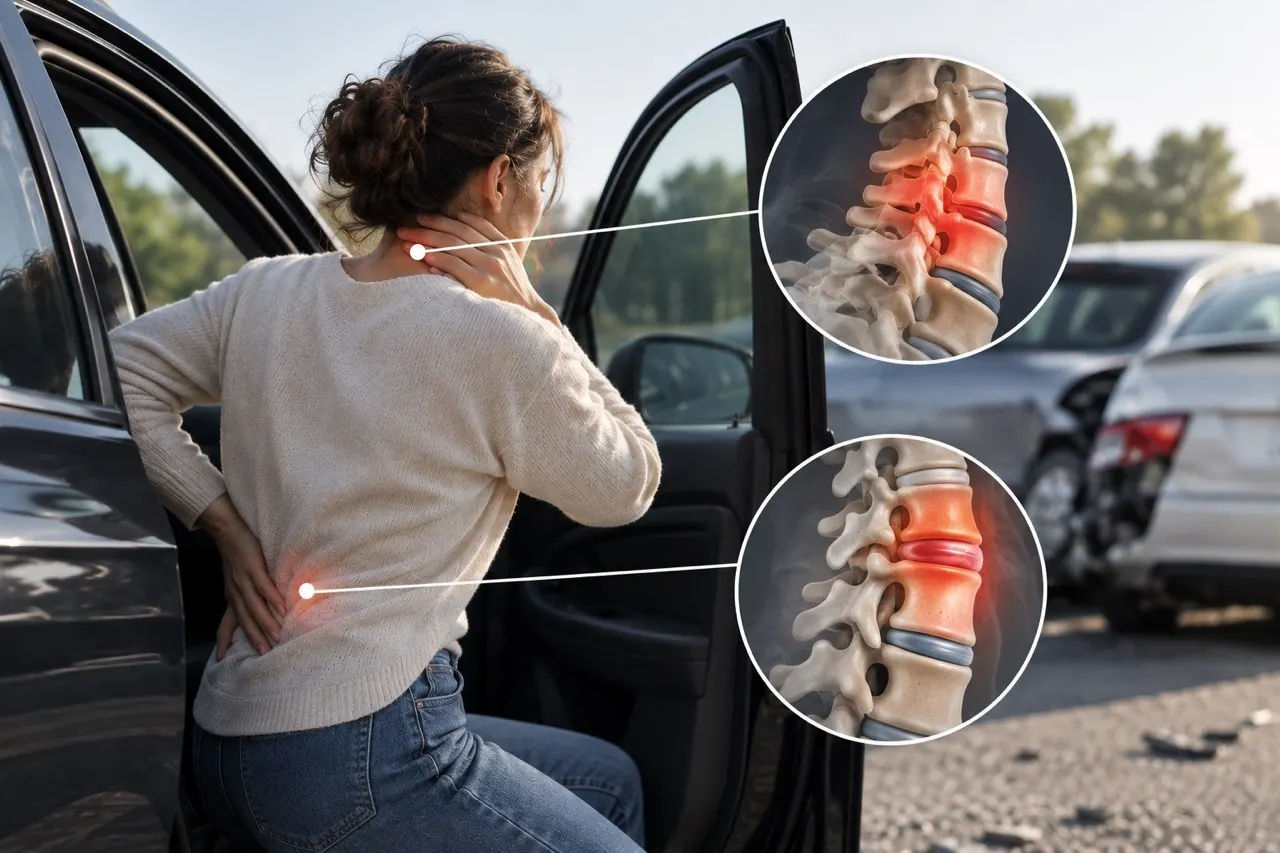
Car accident forces can place stress on the cervical and lumbar discs, potentially contributing to disc injury. Source: AI-generated
Bulging Disc vs. Herniated Disc: What's the Difference?
An intervertebral disc sits between the vertebrae and consists of a soft inner portion called the nucleus pulposus and a tough outer layer called the annulus fibrosus.
With a bulging disc, the outer layer extends beyond its normal boundaries. With a herniated disc, the inner disc material pushes through a weakened or damaged area of the outer layer. Depending on its location, the disc change may affect nearby nerve structures.
| Feature | Bulging Disc | Herniated Disc |
|---|---|---|
| What happens to the disc | The outer part of the disc bulges beyond its normal boundaries. | The inner disc material pushes through a weakened or damaged area of the outer layer. |
| Outer disc layer | The outer layer remains largely intact but extends beyond its normal position. | The outer layer has a tear or weakened area through which the inner material protrudes. |
| Effect on nerve roots | May not affect nearby nerves, but can cause pressure depending on its location. | May touch, irritate, or compress a nearby nerve root depending on its location. |
| Symptoms | May cause no symptoms or may contribute to symptoms if nearby structures are affected. | May cause no symptoms or may cause symptoms when nearby nerve structures are affected. |
The presence of a bulging disc or herniated disc alone does not determine the severity of the condition. What matters is the location and size of the disc change, its effect on surrounding structures, and whether it is causing corresponding symptoms.
Where Can a Disc Injury Occur After a Car Accident?
A disc injury after a car accident can occur in different areas of the spine. Depending on which part of the spine is affected by the forces of the collision, the injury may involve the cervical spine, thoracic spine, or lumbar spine.
- Cervical spine – the neck region of the spine. It is particularly vulnerable to sudden movements during a collision, so the discs in this area can be injured in a car accident.
- Thoracic spine – the middle portion of the spine, located between the neck and lower back. Disc injuries are less common in this area because the thoracic spine is stabilized by the ribs and chest.
- Lumbar spine – the lower back. It bears significant weight and can also be affected by the forces involved in a car accident.
The location of the injury matters because different areas of the spine are connected to different nerve structures. As a result, the type and location of symptoms can depend on which disc and part of the spine are affected.
Symptoms of a Herniated or Bulging Disc After a Car Accident
A disc injury after a car accident can cause a range of symptoms. The type of symptoms often depends on where the affected disc is located and whether it involves nearby nerve structures.
Possible symptoms include:
- neck or back pain;
- pain that radiates into the arm, leg, or another area;
- numbness or tingling;
- muscle weakness;
- limited spinal mobility.
If a disc affects a nerve root, it may cause pain, numbness, tingling, or weakness. However, these symptoms alone do not confirm a herniated disc or bulging disc. A medical evaluation is needed to determine the underlying cause.
If you're experiencing ongoing neck or back symptoms after a car accident, schedule a consultation with NEO Surgical Group. A doctor can evaluate your condition and recommend the appropriate next steps.
Call Now (833) 863-6633Cervical Disc Injury Symptoms
With a disc injury in the cervical spine, pain is most often felt in the neck. If the injury affects a nerve root, the pain or other sensations may radiate from the neck into the shoulder, arm, or hand.
Depending on which nerve is affected, a person may also experience numbness or tingling in these areas. The pattern and location of symptoms depend on the affected disc and the specific nerve structure involved.
Lumbar Disc Injury Symptoms
With a disc injury in the lumbar spine, pain is most often felt in the lower back. If a nerve root is affected, pain or other sensations may radiate into the buttock, leg, or foot.
This pattern of symptoms may be associated with radiculopathy, a condition involving impaired function of a nerve root. When these symptoms follow the path of the sciatic nerve, they are often referred to as sciatica. However, leg pain alone does not necessarily mean that a disc injury is the cause.
Can Herniated or Bulging Disc Symptoms Appear Later?
Symptoms of a herniated disc or bulging disc after a car accident may not appear right away. Immediately after a crash, the body's stress response and adrenaline can make it harder to notice pain or other changes.
Inflammation and tissue irritation can also develop gradually after a collision. If the injury affects nearby nerve structures, related symptoms may become more noticeable over time.
For this reason, the absence of pain immediately after an accident does not rule out a possible disc injury. If neck or back pain, numbness, tingling, weakness, or other unusual symptoms appear or worsen later, they should be evaluated by a healthcare professional.
How Are Disc Injuries Diagnosed After a Car Accident?
Diagnosing a disc injury after a car accident usually starts with a conversation with a doctor. They will ask how the accident happened, when the symptoms began, where the pain is located, and how it has changed over time. Any previous history of spinal problems is also taken into account.
A physical and neurological examination is then performed. The doctor may assess spinal mobility, muscle strength, reflexes, and sensation to evaluate the condition of the nerves and other neurological structures.

A physical and neurological examination can help assess movement, strength, sensation, and possible nerve involvement after a car accident. Source: AI-generated
If needed, additional tests may be ordered. The choice between an X-ray, MRI, CT scan, or other tests depends on the symptoms, examination findings, and suspected cause. Not everyone needs every type of imaging after a car accident.
X-ray, MRI, and CT Scans
Different imaging methods provide different information about the spine, so the choice of test depends on the individual situation.
- X-ray – primarily used to evaluate bone structures. It can help identify fractures, changes in vertebral alignment, and other bone injuries. Intervertebral discs are only seen to a limited extent on standard X-rays.
- MRI – provides detailed images of the intervertebral discs, soft tissues, and nerve structures. It is often used when a possible disc injury or signs of nerve involvement need to be evaluated.
- CT scan – provides detailed images of bone structures and can be used to assess fractures and other spinal injuries. In some situations, a CT scan can also provide additional information alongside other imaging tests.
When EMG or Nerve Testing May Be Used
EMG and nerve conduction studies may be used when symptoms after a car accident suggest possible nerve dysfunction, such as persistent numbness, tingling, or muscle weakness.
These tests help evaluate how the nerves and muscles are functioning and can provide additional information when a physical examination and other tests do not provide a complete picture. However, an EMG is not necessary for everyone with a disc injury. Whether it is appropriate depends on the symptoms and the individual clinical situation.
Treatment for a Herniated or Bulging Disc After a Car Accident
Treatment for a herniated disc after a car accident or bulging disc after car accident depends on the location of the injury, the severity of symptoms, and whether nearby nerve structures are affected. There is no single treatment approach that works for everyone.
Conservative Treatment and Physical Therapy
In many cases, treatment begins with conservative treatment. This may include temporarily modifying physical activity, medication when appropriate, and physical therapy. Rehabilitation can help gradually restore movement and everyday function based on the individual's condition.
Pain Management and Interventional Treatment
If pain persists or interferes with daily activities, a doctor may recommend pain management or other interventional treatments. In some cases, injections may be used when they are appropriate and may help control symptoms.
When Surgery May Be Considered
Significant or persistent neurological symptoms may require evaluation by a specialist in spinal surgery.
Surgery is not necessary for everyone. Surgical treatment may be considered when symptoms are persistent or severe, neurological problems are present, there is significant nerve compression, or other treatments have not provided enough improvement.
Depending on the individual's condition, care may include diagnostic testing, conservative treatment, pain management, rehabilitation, and, when appropriate, evaluation by a neurosurgeon or orthopedic specialist. The treatment plan is tailored to the patient's symptoms and examination findings.
Not sure which treatment option may be appropriate for your symptoms? Schedule a consultation with NEO Surgical Group. A doctor can evaluate your condition and recommend the appropriate next steps.
Call Now (833) 863-6633How Long Does Recovery From a Disc Injury Take?
Recovery from a disc injury after a car accident does not follow a universal timeline. For some people, symptoms gradually improve with conservative treatment, while others may need more time and additional care.
Recovery time depends on the type and location of the injury, the severity of symptoms, whether there is nerve involvement, the treatment being used, and individual factors. For this reason, recovery is assessed based on each person's specific clinical situation.
Can a Car Accident Aggravate a Pre-Existing Disc Problem?
Disc changes do not always develop at the time of a car accident. Disc degeneration, bulging, and other changes may have been present before the accident without causing pain or other noticeable symptoms.
Even when disc changes are found on an MRI or other imaging study, it is not always possible to determine exactly when they developed. Therefore, finding a disc abnormality after a car accident does not, by itself, prove that the accident caused it.
At the same time, a car accident can be followed by new symptoms or a worsening of existing ones. A previously asymptomatic disc condition may become symptomatic after an injury, causing neck or back pain, radiating pain, numbness, tingling, or weakness.
To assess the relationship between the accident and the change in symptoms, a doctor considers more than imaging findings. They may also look at when the symptoms began and how they have changed, the circumstances of the accident, examination findings, and any previous history of spinal problems.
What Can Happen If a Symptomatic Disc Injury Is Left Untreated?
If a disc injury is causing symptoms and is not medically evaluated, those symptoms may persist or, in some cases, worsen over time.. Ongoing neck or back pain can limit movement and interfere with normal physical activity.
When nerve structures are involved, neurological symptoms such as numbness, tingling, and weakness may persist or become more pronounced. In some cases, these symptoms can affect everyday activities, work, or physical activity.
If symptoms persist after a car accident, it is important not to ignore them. A medical evaluation can help determine the underlying cause and guide the next steps.
When Should You See a Doctor After a Car Accident?
After a car accident, you should see a doctor if neck or back pain persists or gets worse, especially if it radiates into your arm or leg. Numbness, tingling, weakness, or symptoms that limit movement and daily activities are also reasons to seek medical attention.
Seek urgent medical care if you develop problems controlling your bladder or bowel movements, numbness or loss of sensation around the groin or buttocks, or sudden or worsening weakness. These symptoms can be signs of serious nerve compression and should not be ignored.
Even if you had no significant symptoms immediately after the accident, you should seek medical attention if new or worsening symptoms develop later.
If you develop new or worsening neck or back symptoms after a car accident, schedule a consultation with NEO Surgical Group. Our doctors can evaluate your symptoms and determine whether additional testing or treatment is needed.
Call Now (833) 863-6633FAQ
Even a relatively minor collision can cause a disc injury if the spine is subjected to sudden acceleration, deceleration, or twisting. However, whether a specific disc change is related to the accident depends on the symptoms, circumstances of the collision, and medical evaluation.
Some herniated discs do not cause severe pain or any noticeable symptoms. The effects often depend on the location of the disc change and whether it affects nearby nerve structures.
A bulging disc and a herniated disc are different types of disc changes. A bulging disc does not necessarily progress to a herniated disc. Disc changes can develop in different ways and do not always lead to symptoms.
A disc problem in the cervical spine can cause neck pain and may sometimes be associated with headaches. However, headaches have many possible causes and do not, by themselves, indicate a herniated disc.
Disc problems can be associated with muscle tension or spasms in the neck or back. However, muscle spasms can also occur for other reasons.
Coughing or sneezing can temporarily increase pain with some disc injuries, particularly when a nerve root is affected. This may be related to increased pressure within the spinal canal.
The forces involved in a car accident can affect more than one disc, including discs in different areas of the spine. For this reason, doctors may evaluate the spine more broadly when symptoms involve multiple areas.
MRI provides detailed images of the intervertebral discs, but the findings need to be considered together with symptoms and physical examination results. Not every disc change seen on an MRI is responsible for a person's symptoms.
Bibliography
- https://medlineplus.gov/herniateddisk.html
- https://www.mayoclinic.org/diseases-conditions/herniated-disk/symptoms-causes/syc-20354095
- https://www.mayoclinic.org/diseases-conditions/herniated-disk/diagnosis-treatment/drc-20354101
- https://my.clevelandclinic.org/health/diseases/12768-herniated-disk
- https://www.spine-health.com/treatment/diagnostic-tests/commonly-confused-terms-diagnosing-spinal-pain
- https://acsearch.acr.org/docs/69483/Narrative/
- https://medlineplus.gov/lab-tests/electromyography-emg-and-nerve-conduction-studies/