
Knee Pain After a Car Accident: Causes, Symptoms, and Treatment
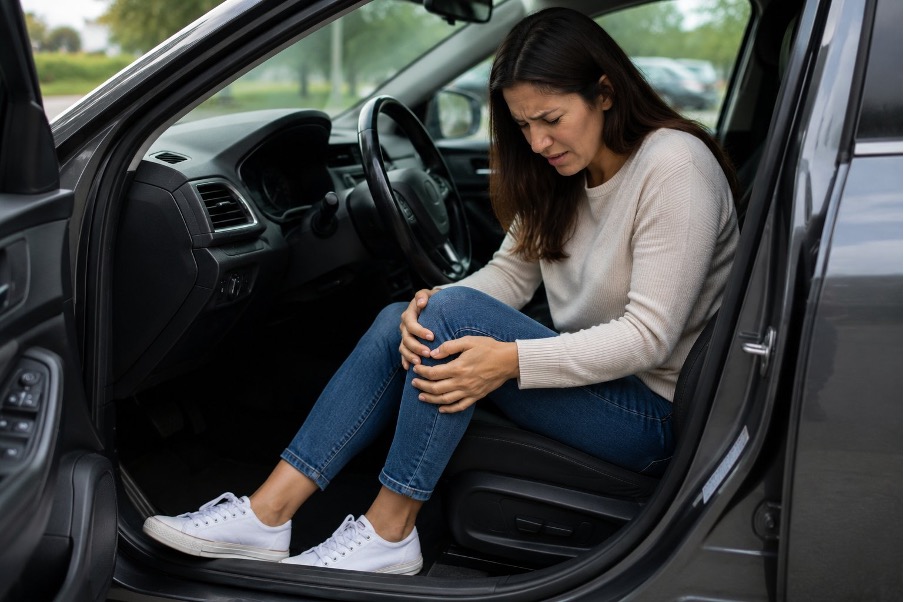
Knee pain after a car accident can develop immediately after the collision or become noticeable several hours or even days later. During a crash, the knee may strike the dashboard, twist as the body shifts, or be subjected to sudden force that can damage the joint and surrounding tissues.
Injuries can range from bruising and other soft tissue damage to ligament tears, meniscus injuries, dislocations, and fractures. Symptoms such as swelling, stiffness, instability, or limited range of motion may provide clues that the knee needs medical evaluation, especially if they persist or worsen.
A car accident can also injure several areas of the body at the same time, including the neck, back, and chest. Paying attention to new or delayed symptoms after a collision can help determine when further evaluation may be needed.
If you're experiencing knee pain, swelling, stiffness, or instability after a car accident, don't wait for symptoms to get worse. Schedule an evaluation to identify the cause of your pain and determine the appropriate next steps for treatment.
📞 Schedule an EvaluationWhy Does Your Knee Hurt After a Car Accident?
During a collision, the knee joint can be exposed to forces far greater than it normally experiences, all within a fraction of a second. Even without a visible injury, sudden body movement or impact with the inside of the vehicle can damage structures in and around the knee.
Common mechanisms of injury include:
- Direct impact – the knee strikes the dashboard, door, or another part of the vehicle.
- Sudden deceleration – the vehicle stops abruptly while the body continues moving forward, placing sudden stress on the knee joint.
- Twisting injury – the foot or lower leg remains relatively fixed while the body suddenly turns or shifts.
- Compression – a strong axial force compresses the structures of the knee joint during the collision.
Direct Impact and Dashboard Injuries
One common mechanism of injury is a direct impact of the bent knee against the dashboard. The force of the impact can injure the kneecap (patella), ligaments, and other structures inside the joint.
The posterior cruciate ligament (PCL) is particularly vulnerable when the dashboard forces the shinbone backward relative to the thighbone. This mechanism is commonly associated with dashboard knee, which is discussed in more detail below.
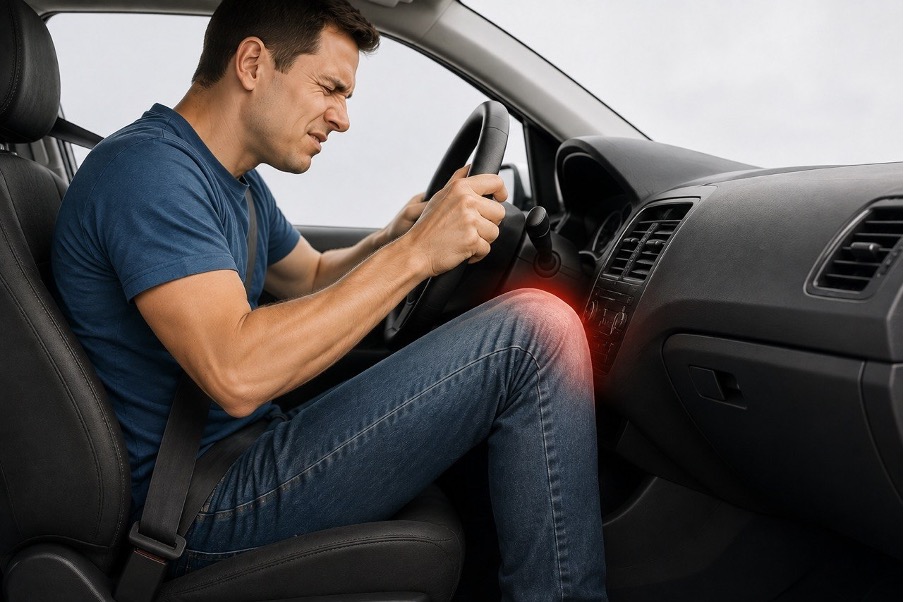
A dashboard impact can force the tibia backward and injure the PCL.
(AI generated)
Twisting and Sudden Rotation
The knee can be injured even without a direct impact. During a collision, the foot or lower leg may remain relatively fixed – for example, against the floor of the vehicle—while the body suddenly shifts or rotates. This can create a twisting injury, placing rotational stress on the knee joint.
This type of movement can damage the ligaments that stabilize the knee, including the ACL (anterior cruciate ligament) and MCL (medial collateral ligament). Twisting combined with pressure on the joint can also injure the meniscus, a cartilage structure that helps distribute load between the bones of the knee.
Hyperextension, Hyperflexion, and Compression
During a collision, the knee can suddenly be forced beyond its normal range of motion. Hyperextension occurs when the joint bends too far backward, while hyperflexion occurs when the knee bends too far forward. These movements place extra stress on the ligaments and other soft tissues of the joint and may cause them to stretch or tear.
Another possible mechanism is compression, in which a strong force compresses the structures of the knee joint. Depending on the force and direction of the impact, this can affect the meniscus, articular cartilage, or bones within the joint.
These mechanisms can occur together during a collision. For example, sudden deceleration may cause the body to shift while the leg twists and the knee is forced into excessive flexion or extension.
Common Knee Injuries After a Car Accident
These injuries can affect the ligaments, menisci, bones, and surrounding soft tissues. The type of injury depends on the position of the leg and the forces involved in the collision, such as a direct impact, twisting motion, or excessive stress on the joint.
ACL Injuries
The ACL (anterior cruciate ligament) helps stabilize the knee and control the movement of the shinbone relative to the thighbone.
An ACL injury after a car accident may involve a sprain or a partial or complete tear of the ligament. During a crash, this can happen when the leg twists suddenly, the knee changes direction abruptly, or the joint is subjected to a strong force. Common signs may include pain, rapidly developing swelling, a feeling of instability, and sometimes a popping sensation at the time of injury.
PCL Injuries and Dashboard Knee
The PCL (posterior cruciate ligament) helps prevent the shinbone from moving too far backward. A classic mechanism of PCL injury after a car accident occurs when the front of a bent knee strikes the dashboard with significant force. The impact can push the tibia backward relative to the thighbone, stretching or tearing the PCL.
This mechanism is commonly referred to as dashboard knee or a dashboard knee injury. Symptoms may include pain, swelling, stiffness, and a feeling that the knee is unstable when walking. With a high-force dashboard impact, the PCL injury may also occur alongside damage to other structures in the knee joint.
MCL and LCL Injuries
The MCL (medial collateral ligament) and LCL (lateral collateral ligament) are located on the inner and outer sides of the knee and help provide side-to-side stability. A strong force from the side during a car accident can overstretch one of these ligaments, resulting in a sprain or tear. Symptoms may include pain along the inner or outer side of the knee, swelling, and a feeling of instability.
Meniscus Tears
The menisci are two pieces of cartilage between the thighbone and shinbone that help distribute load across the knee joint. A meniscus tear after a car accident can occur when the knee twists suddenly or is subjected to both rotational and compressive forces.
This type of injury may cause pain and swelling, as well as knee clicking, catching, knee locking, or limited range of motion.
Kneecap (Patella) Injuries
The patella (kneecap) is particularly vulnerable to a direct impact with the dashboard or another part of the vehicle interior. A strong impact can cause a patella fracture or dislocation of the kneecap. A kneecap injury after a car accident may cause significant pain and swelling, make it difficult to bend or fully straighten the knee, and, in the case of a fracture, make it difficult to put weight on the injured leg.
Tibial Plateau and Other Fractures
A tibial plateau fracture is a break in the upper part of the tibia (shinbone), which forms the lower part of the knee joint. It can occur when the knee is subjected to a strong compressive force or direct impact during a collision. Symptoms may include pain, swelling, and difficulty bearing weight.
Muscle, Tendon, and Soft Tissue Injuries
A direct impact or sudden movement can cause bruising, muscle or tendon strains, inflammation, and other soft tissue injuries. These injuries may lead to localized tenderness, knee bruising, and stiffness, making it harder to move the knee even when there is no serious structural damage.
Get Your Knee Checked
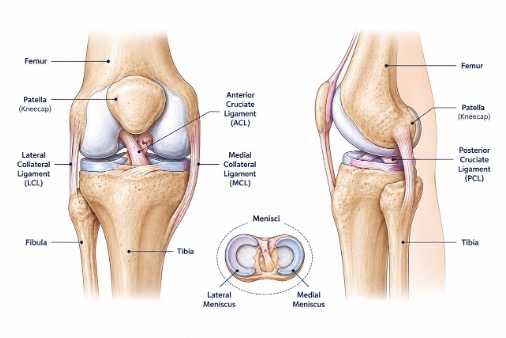
Anatomy of the knee joint and structures commonly affected by trauma.
(AI generated)
Symptoms of a Knee Injury After a Car Accident
Symptoms can vary depending on the type and severity of the damage. The same symptom can occur with different injuries, so symptoms alone cannot determine the exact type of injury.
| Symptom | What It May Feel Like | Possible Injury/Reason |
|---|---|---|
| Pain / tenderness | Pain with movement, touch, or when putting pressure on the knee | Direct impact, soft tissue injury, ligament or meniscus injury, fracture |
| Swelling / bruising | The knee may look swollen, with bruising or tenderness | Inflammation after trauma, bruising, ligament injury, meniscus injury, or fracture |
| Stiffness | The knee feels stiff, especially after a period of rest | Swelling and inflammation following the injury |
| Limited range of motion | Difficulty fully bending or straightening the knee | Swelling or injury to the meniscus, ligaments, or other joint structures |
| Instability | The knee feels like it may give way or buckle while walking | Possible injury to one or more knee ligaments |
| Clicking / popping / locking | Clicking or popping sounds, catching, or temporary locking of the knee | May occur with a meniscus injury or damage to other structures inside the knee |
| Difficulty bearing weight | Pain or difficulty standing or walking on the injured leg | More significant injury to soft tissues, ligaments, bones, or other knee structures |
| Numbness / tingling | Numbness, tingling, or unusual sensations around the knee or farther down the leg | Possible nerve irritation or injury; in a serious injury, circulation may also need to be evaluated |
Having any one of these symptoms does not confirm a specific diagnosis. If swelling, instability, limited range of motion, or knee pain after a car accident persists or worsens, a medical professional can evaluate the symptoms through a physical examination and, when necessary, additional testing.
📞 Schedule an EvaluationCan Knee Pain Appear Days After a Car Accident?
Delayed knee pain after a car accident can occur because some symptoms do not become noticeable immediately after a collision. Pain may develop several hours or even days later, so the absence of significant pain right after the crash does not always mean there was no injury.
After an injury, the body develops an inflammatory response, and swelling may gradually increase. As swelling develops, pain, knee stiffness, and limited range of motion may become more noticeable. With some meniscus injuries, for example, a person may still be able to walk during the first hours after the injury, while swelling and stiffness become more pronounced over the following days.
For this reason, pain that develops days after a car accident should not automatically be considered minor simply because the knee caused little or no discomfort immediately after the collision.
If knee pain appears hours or days after a collision, don't ignore it. Schedule a knee evaluation to identify the cause of your symptoms and determine whether treatment is needed.
📞 Schedule a Knee EvaluationHow Are Knee Injuries Diagnosed After a Car Accident?
Diagnosis starts with a medical examination. Depending on the findings, additional imaging or testing may be recommended.
Physical Examination
The doctor will ask how the collision happened and what happened to the leg at the moment of impact—for example, whether the knee struck the dashboard, twisted suddenly, or was forced into excessive flexion. The doctor will also evaluate the location of pain and swelling, range of motion, knee stability and strength, and the patient's ability to stand and walk on the injured leg.
X-rays
X-rays are primarily used to detect fractures and evaluate the position and condition of the bones. However, a standard X-ray cannot provide a detailed view of ligament or meniscus injuries.
MRI
MRI provides detailed images of the soft tissues of the knee and may be used when an injury to the ACL, PCL, MCL, LCL, meniscus, cartilage, or other structures inside the joint is suspected.
CT and Additional Testing
A CT scan may be used for a more detailed evaluation of certain complex bone injuries, such as a tibial plateau fracture, when the doctor needs a clearer view of the fracture.
Not every patient needs all of these tests after a car accident. The choice of imaging or additional testing depends on the mechanism of injury, symptoms, and findings from the initial examination. If numbness, tingling, or other neurological symptoms are present after the accident, the doctor may also recommend tests to evaluate nerve function, including electromyography in certain cases.
Treatment for Knee Pain After a Car Accident
Treatment for knee pain after a car accident depends on which structures of the knee are injured and how severe the injury is. The treatment plan is determined after an evaluation because, for example, a mild soft tissue injury and an unstable fracture require very different approaches.
Conservative Treatment
For less serious injuries, treatment often begins with conservative treatment. This may include temporarily reducing stress on the knee and modifying activities, applying ice as recommended by a medical professional, and, when needed, using an elastic bandage to support the knee or crutches to reduce weight on the injured leg. Medications may also be recommended to help manage pain and inflammation.
Physical Therapy and Rehabilitation
As the initial symptoms improve, physical therapy and rehabilitation may become an important part of recovery. Rehabilitation typically focuses first on restoring range of motion, followed by improving muscle strength and knee stability. Activity is gradually increased to help the patient safely return to walking and normal daily activities.
Pain Management
If pain persists or interferes with recovery, pain management may be included as part of the treatment plan. The specific approach depends on the diagnosis, the severity of symptoms, and other aspects of the injury. Pain management should be part of a broader treatment plan rather than a substitute for identifying and addressing the cause of the pain.
When Surgery May Be Needed
Surgery is not necessary for every knee injury after a car accident. However, some serious structural injuries – such as certain complete ligament tears, unstable or complex fractures, or injuries involving multiple structures of the knee – may require surgery to restore stability or repair damaged structures.
The decision to proceed with surgery is made by a specialist after an examination and any necessary testing, taking into account the specific type of injury and the patient's functional needs.
How Long Does Knee Pain Last After a Car Accident?
There is no single recovery timeline for a knee injury after a car accident. How long the pain lasts depends largely on the type and severity of the injury. Mild soft tissue injuries, such as bruises or strains, may heal more quickly, while serious ligament injuries, meniscus injuries, or fractures may require a much longer period of treatment and rehabilitation.
Recovery can also be affected by the type and severity of the injury, the patient's age and overall health, how quickly the injury is diagnosed and treated, whether surgery is needed, and consistency with physical therapy and rehabilitation. Returning to normal activities should be gradual and based not only on pain relief but also on the recovery of knee strength, mobility, and stability.
For this reason, persistent knee pain after a car accident should not be judged simply by how many days or weeks have passed. If the pain is not improving, is getting worse, or continues to limit movement and everyday activities, a follow-up evaluation may be needed.
What Happens If a Knee Injury Is Left Untreated?
Some injuries may gradually improve, but more serious damage that is left undiagnosed and untreated can lead to long-term problems with joint function.
Depending on the type of injury, possible consequences may include persistent or chronic knee pain, knee instability, stiffness, and reduced mobility. For example, instability caused by a ligament injury can change how weight and stress are distributed across the joint, while damage to the meniscus or other structures inside the joint may contribute to further cartilage damage.
Some traumatic joint injuries can also increase the risk of post-traumatic arthritis, a form of arthritis that develops after an injury to the joint and may cause pain, stiffness, and limited mobility over time. This does not mean that arthritis will develop after every knee injury; the risk depends on the type and severity of the initial damage.
For this reason, persistent knee pain after a car accident should be evaluated based on its underlying cause rather than managed only as a symptom.
When Should You See a Doctor for Knee Pain After a Car Accident?
A medical evaluation is especially important if knee pain after a car accident is severe, gets worse over time, or significantly limits movement. Being able to walk does not always rule out an injury to the ligaments, meniscus, or other structures of the knee.
You should seek medical attention if you experience:
- severe or worsening knee pain;
- significant swelling or swelling that increases rapidly;
- inability to bear weight on the injured leg;
- visible deformity of the knee;
- knee locking or an inability to fully bend or straighten the knee;
- pronounced knee instability or a feeling that the knee may give way;
- numbness, tingling, or other unusual sensations in the leg.
If knee pain persists, worsens, or limits your movement after a car accident, schedule an evaluation with Neo Surgical Group. Our specialists can assess your injury and recommend the appropriate next steps for treatment.
📞 Schedule an EvaluationFAQ
Knee pain can occur after a car accident because the joint may be exposed to direct impact, twisting, compression, or sudden movement. While some pain may result from relatively minor soft tissue injuries, persistent or worsening pain can also be associated with ligament, meniscus, or bone injuries and may require medical evaluation.
Knee pain may become noticeable hours or days after a collision as inflammation and swelling develop. Delayed pain does not necessarily mean the injury is minor, especially if it is accompanied by stiffness, swelling, instability, or limited movement.
Dashboard knee refers to an injury caused when a bent knee strikes the dashboard during a collision. This impact can force the shinbone backward and may injure the posterior cruciate ligament (PCL) or other structures within the knee.
Yes. A meniscus tear can occur when the knee twists suddenly or experiences a combination of rotational and compressive forces during a crash. Symptoms may include pain, swelling, clicking, catching, or locking of the knee.
Being able to walk immediately after a car accident does not rule out a ligament tear or meniscus injury. Symptoms vary depending on the type and severity of the injury, so the ability to put weight on the leg alone cannot determine how serious the damage is.
Severe or worsening pain, significant swelling, inability to bear weight, visible deformity, knee locking, pronounced instability, numbness, or tingling can indicate that medical evaluation is needed. The severity of an injury cannot be determined from symptoms alone.
A standard X-ray is primarily used to evaluate bones and detect fractures. It does not provide a detailed view of knee ligaments or the meniscus. If a soft tissue injury is suspected, a doctor may recommend an MRI depending on the examination findings.
There is no single recovery timeline. Mild bruising or soft tissue injuries may improve more quickly, while ligament tears, meniscus injuries, fractures, or other significant injuries can require a longer period of treatment and rehabilitation.
A traumatic knee injury can increase the risk of developing post-traumatic arthritis later, particularly when the joint surfaces or other important structures are damaged. However, arthritis is not an inevitable consequence of every knee injury after a car accident.
Swelling can develop as part of the body's inflammatory response to an injury and may become more noticeable in the hours after a collision. It can occur with different types of knee injuries, so swelling alone cannot determine the specific cause.
Bibliography
- https://www.orthoinfo.org/diseases--conditions/meniscus-tears/
- https://www.orthoinfo.org/diseases--conditions/anterior-cruciate-ligament-acl-injuries/
- https://www.orthoinfo.org/diseases--conditions/patellar-kneecap-fractures
- https://medlineplus.gov/ency/patientinstructions/000681.htm
- https://pmc.ncbi.nlm.nih.gov/articles/PMC13049049/
- https://pmc.ncbi.nlm.nih.gov/articles/PMC6105474/
- https://acsearch.acr.org/docs/69419/narrative/
- https://www.mayoclinic.org/diseases-conditions/knee-pain/symptoms-causes/syc-20350849
- https://my.clevelandclinic.org/health/diseases/14616-post-traumatic-arthritis