
Whiplash Symptoms After a Car Accident: Early Signs You Shouldn't Ignore
Neck pain when turning your head, unexpected neck stiffness, or a headache that develops after a car accident may all be whiplash symptoms. They occur when the force of a collision causes the head to snap rapidly in one direction before being thrown back the other way. Even without a direct blow to the head, this sudden motion can injure the soft tissues and other structures of the neck.
Whiplash symptoms may appear immediately after a crash or develop gradually over the next 12 to 72 hours. Many people first notice neck pain, stiffness, headaches, or tightness that extends into the shoulders. Even if these symptoms seem mild, they should not be ignored, as untreated injuries can sometimes lead to ongoing discomfort or chronic pain.
In this article, we'll explain the most common whiplash symptoms, why they may not appear right away, how whiplash after a car accident is diagnosed, how long recovery typically takes, and when it's important to seek medical attention.
What Is Whiplash and How Does It Happen in a Car Accident?
Whiplash is a neck injury that occurs when the head is suddenly forced backward and forward during a collision. This rapid motion places significant stress on the cervical spine and can damage the muscles, ligaments, tendons, facet joints, intervertebral discs, and other structures of the neck.
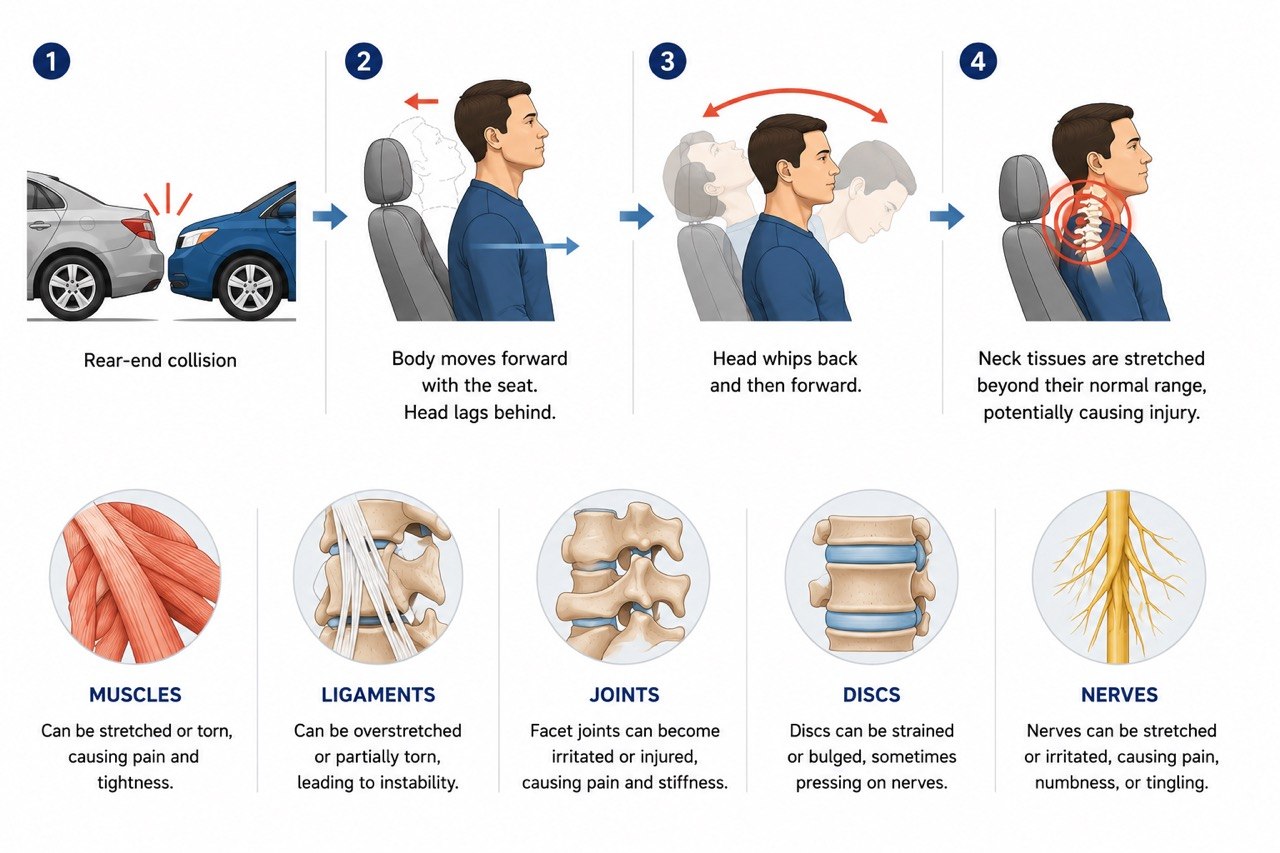
Whiplash injury mechanism after a car accident.
(AI generated)
Whiplash after a car accident is most commonly associated with rear-end collisions, although it can also occur in other types of crashes. When a vehicle is struck from behind, the body moves forward with the seat while the head briefly lags behind because of inertia before being rapidly thrown in the opposite direction. This sudden back-and-forth motion can stretch the tissues of the neck beyond their normal range of movement, resulting in injury.
Depending on the force of the impact, whiplash may affect several structures in the cervical spine, including:
- Muscles – strains or tears of the muscle fibers.
- Ligaments – overstretching or partial tears that can reduce the stability of the neck.
- Facet joints – irritation or injury to the joints that connect the vertebrae.
- Intervertebral discs – damage or displacement of a disc, sometimes accompanied by compression of nearby nerve roots.
- Nerves – stretching or irritation of nerve tissue, which may cause pain, numbness, or tingling.
What Does Whiplash Feel Like?
Although whiplash affects everyone differently, many people describe the first symptoms in similar ways. It often begins with a dull or aching pain in the neck, accompanied by stiffness and muscle tightness that make it difficult to turn or tilt the head comfortably. Some people also describe a feeling that their neck is weak, unstable, or unable to support normal movement.
The discomfort may be barely noticeable immediately after the accident and become more pronounced as inflammation develops. Everyday activities – such as turning your head during a conversation, checking your blind spot while driving, or getting out of bed in the morning – may gradually become painful or noticeably more difficult because of increasing stiffness.
Common Whiplash Symptoms
Whiplash can cause a wide range of symptoms, from neck pain and stiffness to less obvious problems that may not seem related to the injury at first. The table below outlines the most common whiplash symptoms, what they may feel like, and what may be causing them.
Primary Symptoms
| Symptom | What It May Feel Like | Possible Cause |
|---|---|---|
| Neck pain | Dull, aching, or sharp pain that may worsen with movement | Strained muscles, ligaments, facet joints, or other soft tissues |
| Neck stiffness | Difficulty turning or tilting the head; feeling that the neck is "tight" | Muscle spasm, inflammation, or ligament injury |
| Reduced range of motion | Limited ability to look over your shoulder or move your head normally | Pain, swelling, muscle guarding, or joint irritation |
| Shoulder or upper back pain | Aching or tightness spreading into the shoulders or between the shoulder blades | Muscle strain or referred pain from injured neck structures |
| Headaches | Pain starting at the base of the skull and spreading toward the forehead | Irritation of muscles, joints, or nerves in the neck |
Additional Symptoms
| Symptom | What It May Feel Like | Possible Cause |
|---|---|---|
| Dizziness | Feeling unsteady or off balance | Changes in neck function or irritation of nearby structures |
| Tingling or numbness | "Pins and needles" in the shoulder, arm, or hand | Irritated or compressed nerve roots |
| Fatigue | Feeling unusually tired even after rest | The body's response to pain and injury |
| Difficulty concentrating | Trouble focusing or feeling mentally "foggy" | Pain, stress, poor sleep, or associated injury |
| Jaw pain or ringing in the ears | Discomfort while chewing or persistent ringing | Less common symptoms that may occur after neck trauma in some people |

Neck pain and stiffness are among the most common symptoms of whiplash after a car accident.
(AI generated)
Delayed Whiplash Symptoms
Not everyone develops whiplash symptoms immediately after a car accident. During the first few hours, the body's stress response releases adrenaline and other hormones that can temporarily reduce the perception of pain. As these effects wear off and inflammation develops in the injured tissues, symptoms often become more noticeable.
For this reason, delayed whiplash symptoms commonly appear 12 to 72 hours after a collision. Feeling fine immediately after an accident does not necessarily mean your neck escaped injury.
The symptoms that most often develop later include:
- Neck pain that gradually worsens
- Neck stiffness
- Headaches, especially those that begin at the base of the skull
- Pain that spreads into the shoulders or upper back
- Muscle spasms
- Dizziness
If your symptoms appear several hours or even days after a car accident, or if they continue to worsen, it's important to see a doctor for an evaluation. Early diagnosis and treatment can help prevent long-term complications and support a smoother recovery.
Concerned about your symptoms? Call today.
📞 Call (833) 863-6633Neck pain is one of the most common symptoms of whiplash after a crash. Learn when it may indicate a more serious injury in our article Neck Pain After a Car Accident: When It's Serious and How It's Treated.
When Are Whiplash Symptoms a Medical Emergency?
| Symptom | Why It's Dangerous |
|---|---|
| Severe or rapidly worsening neck pain | May indicate a serious cervical spine injury or spinal instability. |
| Weakness, numbness, or loss of sensation in the arms or legs | May be a sign of spinal cord injury or significant nerve compression. |
| Loss of bladder or bowel control | May indicate severe spinal cord damage and requires immediate medical evaluation. |
| Difficulty walking or loss of coordination | May suggest injury to the spinal cord or brain. |
| Loss of consciousness, repeated vomiting, severe confusion, or seizures | May indicate a concussion or a more serious traumatic brain injury rather than whiplash alone. |
| Difficulty breathing or swallowing | May be a sign of a serious neck injury or significant swelling affecting the airway. |
Although most cases of whiplash are not life-threatening, some symptoms may indicate a more serious injury and require immediate medical attention.
How Is Whiplash Diagnosed?
In most cases, whiplash is diagnosed based on your symptoms, the details of the accident, and the findings from a physical examination. During your appointment, the doctor will ask how the collision occurred, when your symptoms began, and whether they have changed over time.
The examination typically includes an assessment of your neck's range of motion, areas of tenderness, muscle tension, and other signs of injury. A neurological examination may also be performed to evaluate muscle strength, sensation, and reflexes and determine whether the nerves may have been affected.
If needed, your doctor may recommend additional imaging or diagnostic tests.
| Diagnostic Test | When It's Used | What It Can Show |
|---|---|---|
| X-ray | If a fracture, dislocation, or spinal instability is suspected | Evaluates the bones but does not show soft tissue injuries. |
| CT scan | After a high-impact collision or when a serious spinal injury is suspected | Provides detailed images of the bones and can detect fractures that may not be visible on an X-ray. |
| MRI | If pain persists, neurological symptoms develop, or a soft tissue injury is suspected | Evaluates the intervertebral discs, ligaments, muscles, spinal cord, and nerve structures. |
If numbness, tingling, or weakness in the arm persists after a car accident, your doctor may suspect nerve involvement. In these cases, electromyography may be recommended to evaluate how well the nerves and muscles are functioning. This test can help determine whether your symptoms are related to nerve damage.
Get an accurate diagnosis today
📞 Call (833) 863-6633Whiplash vs. Concussion: What's the Difference?
Both whiplash and concussion can occur during the same car accident. In fact, these injuries often happen together because the force that causes the head to move suddenly can affect both the neck and the brain. Although they share some symptoms, they are different conditions that require different approaches to diagnosis and treatment.
| Feature | Whiplash | Concussion |
|---|---|---|
| Primary injury | Injury to the muscles, ligaments, joints, discs, and other structures of the neck | A mild traumatic brain injury |
| Pain location | Usually the neck, shoulders, or upper back | Most often a headache, sometimes accompanied by neck pain |
| Common symptoms | Neck pain, stiffness, reduced range of motion, and muscle spasms | Headache, confusion, memory and concentration problems, sensitivity to light or noise |
| Neurological symptoms | Tingling or numbness if nerves are irritated or compressed | Memory, balance, attention, or consciousness may be affected |
| Loss of consciousness | Not typical | Possible, but not common |
| Typical diagnostic tests | Physical examination, with X-ray, CT, or MRI if needed | Neurological examination, cognitive assessment, and CT or MRI if needed to rule out a more serious brain injury |
If neck pain after a car accident is accompanied by confusion, excessive drowsiness, memory problems, repeated vomiting, or loss of consciousness, seek medical attention as soon as possible. These symptoms may indicate a concussion or another traumatic brain injury, rather than whiplash alone.
Learn more about the symptoms, diagnosis, and treatment of concussion in our article Concussion Symptoms After a Car Accident.
Treatment for Whiplash After a Car Accident
Treatment for whiplash after a car accident depends on the severity of the injury, your symptoms, and the results of your evaluation. Most people recover without surgery, and treatment typically begins with conservative care before progressing to other options if needed.
Conservative Treatment
Conservative treatment is usually the first step in recovery. Depending on your symptoms, your doctor may recommend a short period of rest, ice or heat therapy, and medications to help relieve pain and reduce inflammation. Your treatment plan will be tailored to your individual condition and recovery goals.
Physical Therapy
As acute pain begins to improve, physical therapy becomes an important part of recovery. Targeted exercises help restore neck mobility, reduce stiffness, strengthen the supporting muscles, and gradually return you to normal daily activities.
Pain Management
If pain persists or begins to interfere with your daily life, your doctor may recommend additional pain management options. Depending on the source of your symptoms, treatment may include medications and other nonsurgical approaches to improve comfort and function.
Diagnostic and Therapeutic Injections
In some cases, pain originates from the facet joints or nearby nerves. If this is suspected, your doctor may recommend diagnostic or therapeutic injections. These injections can help identify the source of pain and, in some cases, provide long-lasting symptom relief.
Surgery
Most people with whiplash recover without surgery. However, if the accident causes serious structural damage, such as spinal instability, certain fractures, or significant nerve compression, surgical treatment may be considered. In these cases, evaluation by specialists in neurosurgery and orthopedics can help determine the most appropriate treatment plan.
Stay Active During Recovery
As you recover, it's important to gradually return to your normal daily activities. Prolonged bed rest is generally no longer recommended because it can increase stiffness and slow the recovery process. Instead, staying moderately active and following your doctor's recommendations can help restore neck function and support a faster recovery.
Find the right treatment for your injury
📞 Call (833) 863-6633How Long Does Whiplash Last?
How long does whiplash last depends on several factors, including the severity of the injury and how soon treatment begins. For many people, symptoms start to improve within the first few weeks, and recovery often takes about 4 to 6 weeks.
Moderate injuries may require 6 weeks to 3 months to heal. If the injury involves the nerves, intervertebral discs, or other complications, symptoms can persist for several months or longer.
Although most people make a full recovery, the healing process varies from person to person. Following your doctor's recommendations, starting treatment early, and gradually returning to normal activities can support recovery and help reduce the risk of chronic pain.
What Can Affect Recovery?
Even with the same diagnosis, recovery can vary from one person to another. How long does whiplash take to heal depends not only on the injury itself but also on several individual factors.
Some of the most important include the severity of the injury, the force of the collision, your age, and whether you have had previous neck injuries or chronic conditions affecting the cervical spine. Seeking medical care promptly and following your recommended treatment plan can also have a significant impact on recovery.
What Happens If Whiplash Is Left Untreated?
Not every whiplash injury leads to long-term complications, but persistent symptoms should not be ignored. If neck pain, stiffness, or limited range of motion does not improve, delaying treatment may make recovery more difficult and increase the risk of ongoing problems.
For some people, untreated whiplash can lead to chronic neck pain that lasts for months or even longer. Persistent muscle tension and reduced mobility may interfere with everyday activities, work, sleep, and overall quality of life.
In some cases, injury to the tissues of the neck may contribute to cervical radiculopathy, a condition in which a nerve root becomes irritated or compressed. This can cause pain, numbness, tingling, or weakness that radiates into the shoulder, arm, or hand.
When Should You See a Doctor?
Mild neck discomfort after a car accident does not always mean you have a serious injury. However, if your symptoms do not improve or begin to interfere with your daily life, you should not delay a medical evaluation.
It's a good idea to see a doctor if:
- Neck pain lasts longer than 24 to 48 hours or gradually becomes worse
- Turning or tilting your head becomes difficult
- Pain spreads into your shoulder, arm, or upper back
- You develop numbness, tingling, or weakness in your arm
- Your symptoms make it difficult to work, sleep, or carry out your usual daily activities
Even if your symptoms seem mild, an early evaluation can help confirm the diagnosis, rule out more serious injuries, and begin treatment before the condition becomes more difficult to manage.
Talk to a specialist before symptoms get worse
📞 Call (833) 863-6633If you're experiencing symptoms beyond neck pain, such as chest pain after a car accident, it's important to understand what may be causing them. Learn more in our article Chest Pain After a Car Accident: What Causes It and When to Seek Treatment.
FAQ
Some people notice symptoms immediately after a car accident, while others develop them over the next few days. Delayed symptoms are common and do not necessarily mean the injury is more or less severe.
Recovery varies from person to person. Mild cases often improve within a few weeks, while more severe injuries may require several months of treatment and rehabilitation.
Mild whiplash may improve without extensive treatment, but persistent pain, stiffness, or limited neck movement should always be evaluated by a healthcare provider. Early treatment may help reduce the risk of long-term symptoms.
Even collisions at relatively low speeds can generate enough force to injure the soft tissues of the neck, particularly in rear-end collisions.
Headaches are one of the most common whiplash symptoms and often begin at the base of the skull before spreading toward the forehead.
Pain may spread from the neck into the shoulders or upper back because the muscles and connective tissues in these areas work together. If shoulder pain becomes severe or persistent, further evaluation may be needed.
Ice is often recommended during the first 24-48 hours to help reduce pain and swelling. Heat may be more helpful later, once the acute phase has passed and muscle stiffness becomes the main concern.
It depends on your symptoms. If neck pain or reduced range of motion makes it difficult to safely check traffic or blind spots, you should avoid driving until you have been evaluated and your mobility improves.
If neck pain lasts longer than 24-48 hours, gets worse, limits your movement, or is accompanied by numbness, weakness, or tingling, you should schedule a medical evaluation.
Get Expert Care After a Car Accident
Don't ignore neck pain, stiffness, headaches, or delayed symptoms after a car accident. Call (833) 863-6633 or complete the form below to request an evaluation.
Bibliography
- https://www.mayoclinic.org/diseases-conditions/whiplash/symptoms-causes/syc-20378921
- https://www.mayoclinic.org/diseases-conditions/whiplash/diagnosis-treatment/drc-20378926
- https://my.clevelandclinic.org/health/diseases/11982-whiplash
- https://www.hopkinsmedicine.org/health/conditions-and-diseases/whiplash-injury
- https://www.healthdirect.gov.au/whiplash